Organic Chemistry
My Course
Learn
Exam Prep
AI Tutor
Study Guides
Textbook Solutions
Flashcards
Explore
Try the app
My Course
Learn
Exam Prep
AI Tutor
Study Guides
Textbook Solutions
Flashcards
Explore
Try the app
Back
Orbital Diagram:Excited States quiz
You can tap to flip the card.
What happens to electrons in conjugated molecules when they absorb light energy?
You can tap to flip the card.
👆
What happens to electrons in conjugated molecules when they absorb light energy?
Electrons are excited to higher energy states, changing their orbital configurations.
Track progress
Control buttons has been changed to "navigation" mode.
1/15
Related flashcards
Related practice
Recommended videos
Orbital Diagram:Excited States definitions
Orbital Diagram:Excited States
14 Terms
Pericyclic Reaction
16. Conjugated Systems
1 problem
Topic

Johnny
16. Conjugated Systems - Part 1 of 3
4 topics
15 problems
Chapter
Johnny
16. Conjugated Systems - Part 2 of 3
6 topics
14 problems
Chapter
Johnny
16. Conjugated Systems - Part 3 of 3
6 topics
14 problems
Chapter
Johnny
Guided course
03:08
Ground vs. Excited States
2
views
Terms in this set (15)
Hide definitions
What happens to electrons in conjugated molecules when they absorb light energy?
Electrons are excited to higher energy states, changing their orbital configurations.
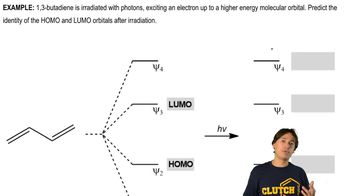
How does electron excitation affect the HOMO and LUMO of a molecule?
The identities of the HOMO and LUMO change because electrons occupy different orbitals after excitation.
What is the ground state configuration of 1,3-butadiene's pi electrons?
1,3-butadiene has four pi electrons filled according to the Aufbau principle in its ground state.
Which orbital is the HOMO in the ground state of 1,3-butadiene?
The HOMO is orbital psi 2 in the ground state.
Which orbital is the LUMO in the ground state of 1,3-butadiene?
The LUMO is orbital psi 3 in the ground state.
What causes an electron to move from HOMO to LUMO in 1,3-butadiene?
Irradiation with photons (light) excites an electron from HOMO to LUMO.
After irradiation, which orbital becomes the HOMO in 1,3-butadiene?
After irradiation, orbital psi 3 becomes the HOMO.
After irradiation, which orbital becomes the LUMO in 1,3-butadiene?
After irradiation, orbital psi 4 becomes the LUMO.
Why is the manipulation of HOMO and LUMO using light important?
It allows control over which orbitals react, impacting the molecule's reactivity.
Does the spin of the excited electron matter when predicting HOMO and LUMO?
No, only the orbital location matters, not the electron's spin.
What principle is used to fill the pi electrons in the ground state?
The Aufbau principle is used to fill the pi electrons in order of increasing energy.
How many pi electrons does 1,3-butadiene have in its ground state?
It has four pi electrons in its ground state.
What is the effect of shining light on a conjugated molecule?
Shining light excites electrons to higher energy orbitals, altering the HOMO and LUMO.
What is the mechanical energy conversion in conjugated molecules upon light absorption?
Light energy is converted into mechanical energy by exciting electrons to higher states.
How can light be used to manipulate molecular reactivity in conjugated systems?
By exciting electrons, light changes which orbitals act as HOMO and LUMO, thus affecting reactivity.