Back

Orbital Diagram:Excited States definitions

Control buttons has been changed to "navigation" mode.
1/14
  • Conjugated Molecule

    A structure with alternating single and double bonds, allowing delocalization of pi electrons across multiple atoms.
  • Photon

    A quantum of light energy capable of exciting electrons to higher energy orbitals in molecules.
  • Electron Excitation

    The process where an electron absorbs energy and moves from a lower to a higher energy molecular orbital.
  • Ground State

    The lowest energy configuration of electrons in a molecule, with all electrons in the lowest available orbitals.
  • Excited State

    A higher energy configuration where one or more electrons occupy orbitals above their ground state positions.
  • HOMO

    The molecular orbital containing the highest energy electrons that are still occupied in a given state.
  • LUMO

    The lowest energy molecular orbital that does not contain electrons but can accept them upon excitation.
  • Pi Electron

    An electron found in a molecular orbital formed by the sideways overlap of adjacent p orbitals in conjugated systems.
  • Molecular Orbital

    A region in a molecule where electrons are likely to be found, formed by the combination of atomic orbitals.
  • Aufbau Principle

    A rule stating that electrons fill molecular orbitals starting from the lowest energy level upwards.
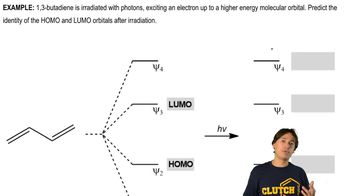
  • Psi 2

    The second molecular orbital in energy order, often serving as the HOMO in the ground state of 1,3-butadiene.
  • Psi 3

    The third molecular orbital in energy order, which can become the HOMO after electron excitation in 1,3-butadiene.
  • Psi 4

    The fourth molecular orbital in energy order, which becomes the LUMO after electron excitation in 1,3-butadiene.
  • Reactivity

    The tendency of a molecule to undergo chemical change, influenced by the arrangement of electrons in orbitals.