Organic Chemistry
My Course
Learn
Exam Prep
AI Tutor
Study Guides
Textbook Solutions
Flashcards
Explore
Try the app
My Course
Learn
Exam Prep
AI Tutor
Study Guides
Textbook Solutions
Flashcards
Explore
Try the app
Back
Orbital Diagram:6-atoms- 1,3,5-hexatriene quiz
You can tap to flip the card.
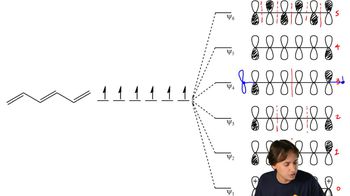
How many atomic orbitals, pi electrons, and molecular orbitals are present in 1,3,5-hexatriene?
You can tap to flip the card.
👆
How many atomic orbitals, pi electrons, and molecular orbitals are present in 1,3,5-hexatriene?
There are 6 atomic orbitals, 6 pi electrons, and 6 molecular orbitals in 1,3,5-hexatriene.
Track progress
Control buttons has been changed to "navigation" mode.
1/15
Related flashcards
Related practice
Recommended videos
Orbital Diagram:6-atoms- 1,3,5-hexatriene definitions
Orbital Diagram:6-atoms- 1,3,5-hexatriene
15 Terms
Orbital Diagram: 6-atoms- 1,3,5-hexatriene
16. Conjugated Systems
1 problem
Topic

Johnny
16. Conjugated Systems - Part 1 of 3
4 topics
15 problems
Chapter
Johnny
16. Conjugated Systems - Part 2 of 3
6 topics
14 problems
Chapter
Johnny
16. Conjugated Systems - Part 3 of 3
6 topics
14 problems
Chapter
Johnny
Guided course
13:25
Drawing MO Diagrams
2
views
Terms in this set (15)
Hide definitions
How many atomic orbitals, pi electrons, and molecular orbitals are present in 1,3,5-hexatriene?
There are 6 atomic orbitals, 6 pi electrons, and 6 molecular orbitals in 1,3,5-hexatriene.
What is the general rule for the number of nodes in each molecular orbital for a conjugated system?
The number of nodes increases by one for each higher molecular orbital, starting from zero up to n-1, where n is the number of atomic orbitals.
Where should the first and last orbitals be filled in when drawing molecular orbitals for hexatriene?
The first and last orbitals should be filled in for all molecular orbitals as a starting point.
How is the sixth molecular orbital (Psi 6) typically drawn in hexatriene?
Psi 6 is drawn with every single orbital facing a different direction, alternating phases.
What technique can be used to determine node placement in complex molecular orbitals like Psi 4 and Psi 5?
A sine wave is drawn using fake atoms at positions 0 and n+1 to guide symmetrical node placement.
Why is symmetry important when placing nodes in molecular orbitals?
Symmetry ensures that the resulting molecular orbitals are as even and stable as possible, matching the true wave function.
For even-numbered molecular orbitals, can nodes pass through an orbital?
No, for even-numbered molecular orbitals, nodes should not pass through an orbital.
How many nodes does Psi 3 have in the hexatriene molecular orbital diagram?
Psi 3 has two nodes.
What is the shortcut method for drawing molecular orbitals without complex math?
The shortcut involves using symmetry and sine wave guides to place nodes, avoiding detailed quantum calculations.
Why are all electrons in hexatriene found in bonding orbitals in the ground state?
All electrons fill the lowest energy (bonding) orbitals first, which increases molecular stability.
What are the consequences of electrons occupying anti-bonding orbitals?
Electrons in anti-bonding orbitals decrease the stability of the molecule.
How do you identify the HOMO and LUMO in the molecular orbital diagram of hexatriene?
The highest occupied molecular orbital (HOMO) is Psi 3, and the lowest unoccupied molecular orbital (LUMO) is Psi 4.
Why are there no non-bonding orbitals in the hexatriene molecular orbital diagram?
There are no non-bonding orbitals because there is no orbital at the halfway point in a six-atom system.
What is the main advantage of the sine wave method for node placement?
It provides a visually intuitive and symmetrical way to place nodes, leading to correct molecular orbital shapes.
What is the relationship between the number of nodes and the energy of a molecular orbital?
As the number of nodes increases, the energy of the molecular orbital also increases.