Organic Chemistry
My Course
Learn
Exam Prep
AI Tutor
Study Guides
Textbook Solutions
Flashcards
Explore
Try the app
My Course
Learn
Exam Prep
AI Tutor
Study Guides
Textbook Solutions
Flashcards
Explore
Try the app
Back
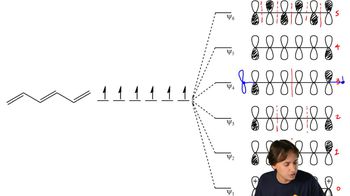
Orbital Diagram:6-atoms- 1,3,5-hexatriene definitions
You can tap to flip the card.
Hexatriene
You can tap to flip the card.
👆
Hexatriene
A linear conjugated hydrocarbon with six carbon atoms and alternating double bonds, serving as a model for six-atom pi systems.
Track progress
Control buttons has been changed to "navigation" mode.
1/15
Related flashcards
Related practice
Recommended videos
Orbital Diagram:6-atoms- 1,3,5-hexatriene quiz
Orbital Diagram:6-atoms- 1,3,5-hexatriene
15 Terms
Orbital Diagram: 6-atoms- 1,3,5-hexatriene
16. Conjugated Systems
1 problem
Topic

Johnny
16. Conjugated Systems - Part 1 of 3
4 topics
15 problems
Chapter
Johnny
16. Conjugated Systems - Part 2 of 3
6 topics
14 problems
Chapter
Johnny
16. Conjugated Systems - Part 3 of 3
6 topics
14 problems
Chapter
Johnny
Guided course
13:25
Drawing MO Diagrams
2
views
Terms in this set (15)
Hide definitions
Hexatriene
A linear conjugated hydrocarbon with six carbon atoms and alternating double bonds, serving as a model for six-atom pi systems.
Conjugated System
A structure with alternating single and double bonds, allowing pi electrons to delocalize across multiple atoms.
Molecular Orbital
A region formed by the combination of atomic orbitals where electrons are likely to be found in a molecule.
Atomic Orbital
A mathematical function describing the probability of finding an electron around a single atom.
Pi Electron
An electron found in a pi bond, which results from the sideways overlap of adjacent p orbitals.
Node
A location in an orbital where the probability of finding an electron is zero, often used to distinguish different molecular orbitals.
Symmetry
A property ensuring that molecular orbitals and their nodes are evenly distributed, often guided by sine wave patterns.
Sine Wave
A graphical tool used to guide the placement of nodes in molecular orbitals for optimal symmetry.
Bonding Orbital
A molecular orbital where electron density is concentrated between nuclei, increasing molecular stability.
Antibonding Orbital
A molecular orbital with a node between nuclei, where electron presence decreases molecular stability.
HOMO
The highest energy molecular orbital that contains electrons in the ground state configuration.
LUMO
The lowest energy molecular orbital that does not contain electrons but can accept them.
Phase
The sign or direction of an orbital lobe, which alternates across nodes and affects orbital interactions.
Resonance
A phenomenon where electrons are delocalized across a conjugated system, stabilizing the molecule.
Nonbonding Orbital
An orbital that neither increases nor decreases molecular stability, typically absent in even-numbered conjugated systems.