Back

Orbital Diagram:5-atoms- Allylic Ions quiz

Control buttons has been changed to "navigation" mode.
1/15
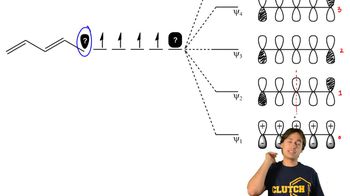
  • What is the first step in drawing molecular orbital diagrams for a 5-atom conjugated system?

    The first step is to fill in the first atomic orbital consistently across all five atoms.
  • How do you determine the number of nodes in the molecular orbitals of a 5-atom system?

    The number of nodes increases from 0 to 4 as you move from the lowest to the highest energy orbital.
  • Where should the first node be placed when drawing a molecular orbital with one node for a 5-atom system?

    The first node should be placed in the middle to maintain symmetry.
  • How are two nodes placed symmetrically in a 5-atom molecular orbital?

    Two nodes are placed at positions 2 and 4 to keep the diagram symmetrical.
  • What is the rule for placing three nodes in a 5-atom molecular orbital?

    One node is placed in the middle, and the other two are spaced evenly to maintain symmetry.
  • What does it mean if every position in a 5-atom molecular orbital has a node?

    It means you are drawing the highest energy orbital, which has four nodes.
  • How do you identify bonding, non-bonding, and anti-bonding orbitals in a 5-atom system?

    Bonding orbitals are below the 50% mark, anti-bonding orbitals are above, and the orbital at the midpoint is non-bonding.
  • What is special about the Psi 3 orbital in a 5-atom conjugated system?

    Psi 3 is non-bonding, located at the midpoint, and is typically the most reactive orbital.
  • Why is the non-bonding orbital considered reactive in a 5-atom system?

    Because it can interact with other ions and molecules and is often where reactions occur.
  • How are pi electrons filled into the molecular orbitals of a 5-atom system?

    Two electrons fill Psi 1, two fill Psi 2, and the remaining electron(s) go into the next available orbital depending on the system.
  • In Psi 3 of a 5-atom system, at which positions do orbitals exist?

    Orbitals exist at positions a, c, and e; positions b and d have nodes.
  • Why can resonance in a 5-atom allylic ion only occur at certain positions?

    Because only positions without nodes in the non-bonding orbital can participate in resonance.
  • What notation is used to indicate anti-bonding orbitals in a molecular orbital diagram?

    A star (*) is added to the orbital symbol to indicate it is anti-bonding.
  • Does the non-bonding orbital add or subtract from the stability of the molecule?

    No, the non-bonding orbital neither adds nor subtracts from the molecule's stability.
  • What is the main purpose of drawing molecular orbital diagrams for conjugated systems?

    The main purpose is to explain the reactivity and resonance behavior of the molecule.