Back

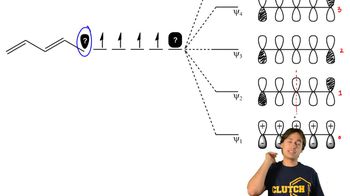
Orbital Diagram:5-atoms- Allylic Ions definitions

Control buttons has been changed to "navigation" mode.
1/15
  • Molecular Orbital Diagram

    A visual representation showing the arrangement and energy levels of orbitals formed from atomic orbitals in a conjugated system.
  • Conjugated System

    A structure with alternating single and multiple bonds, allowing for delocalization of electrons across several atoms.
  • Atomic Orbital

    A region around a nucleus where an electron is likely to be found, serving as the basis for constructing molecular orbitals.
  • Node

    A location within an orbital where the probability of finding an electron is zero, crucial for determining orbital symmetry.
  • Bonding Orbital

    An energy state formed below the midpoint, increasing molecular stability by allowing electron sharing between atoms.
  • Antibonding Orbital

    An energy state above the midpoint, marked with a star, which decreases molecular stability when occupied by electrons.
  • Non-bonding Orbital

    An energy state at the midpoint, neither stabilizing nor destabilizing, often serving as the most reactive site in the molecule.
  • Phase

    The sign or direction of the wave function in an orbital, which alternates to maintain symmetry and determine orbital interactions.
  • Psi 3

    A specific molecular orbital in a five-atom system, notable for its unique node arrangement and high reactivity.
  • Pi Electron

    An electron occupying a molecular orbital formed from the sideways overlap of p orbitals, contributing to delocalization.
  • Resonance

    A phenomenon where electron density is spread over multiple positions, allowing for reactivity at several sites in a molecule.
  • LCAO Model

    A method for constructing molecular orbitals by combining atomic orbitals linearly, predicting orbital shapes and energies.
  • Symmetry

    A property ensuring nodes and phases are evenly distributed, maintaining balance in molecular orbital diagrams.
  • Energy Level

    A quantized state indicating the relative stability of an orbital, with lower levels being more stable.
  • Star Notation

    A symbol used to indicate antibonding orbitals in diagrams, distinguishing them from bonding and non-bonding states.