Organic Chemistry
My Course
Learn
Exam Prep
AI Tutor
Study Guides
Textbook Solutions
Flashcards
Explore
Try the app
My Course
Learn
Exam Prep
AI Tutor
Study Guides
Textbook Solutions
Flashcards
Explore
Try the app
Back
Orbital Diagram:4-atoms- 1,3-butadiene quiz
You can tap to flip the card.
What is the general structure of a 4-atom pi conjugated system called?
You can tap to flip the card.
👆
What is the general structure of a 4-atom pi conjugated system called?
A 4-atom pi conjugated system is usually called a diene, which can also be generalized as a polyene.
Track progress
Control buttons has been changed to "navigation" mode.
1/15
Related flashcards
Related practice
Recommended videos
Orbital Diagram:4-atoms- 1,3-butadiene definitions
Orbital Diagram:4-atoms- 1,3-butadiene
15 Terms
16. Conjugated Systems - Part 1 of 3
4 topics
15 problems
Chapter
Johnny
16. Conjugated Systems - Part 2 of 3
6 topics
14 problems
Chapter
Johnny
16. Conjugated Systems - Part 3 of 3
6 topics
14 problems
Chapter
Johnny
Guided course
06:20
Alternative MO Notation for Dienes
3
views
Guided course
04:43
Drawing MO Diagram for Dienes
2
views
Terms in this set (15)
Hide definitions
What is the general structure of a 4-atom pi conjugated system called?
A 4-atom pi conjugated system is usually called a diene, which can also be generalized as a polyene.
How many pi electrons are present in 1,3-butadiene?
There are 4 pi electrons in 1,3-butadiene, corresponding to its two pi bonds.
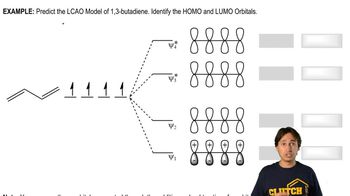
According to the Aufbau principle, how are the electrons distributed in the molecular orbitals of 1,3-butadiene?
Two electrons occupy Psi 1 and two electrons occupy Psi 2, with Psi 3 and Psi 4 remaining empty.
What is the first step in drawing the molecular orbitals for a 4-atom conjugated system?
The first step is to draw the atomic orbitals and shade the first orbital without any phase changes.
How do you increase the number of nodes when drawing molecular orbitals for 1,3-butadiene?
You increase nodes by introducing phase changes symmetrically between the atomic orbitals as you move to higher energy orbitals.
Which molecular orbital is the HOMO in 1,3-butadiene?
Psi 2 is the HOMO (Highest Occupied Molecular Orbital) in 1,3-butadiene.
Which molecular orbital is the LUMO in 1,3-butadiene?
Psi 3 is the LUMO (Lowest Unoccupied Molecular Orbital) in 1,3-butadiene.
What are frontier orbitals in the context of molecular orbital theory?
Frontier orbitals refer to the HOMO and LUMO, which are important for chemical reactivity.
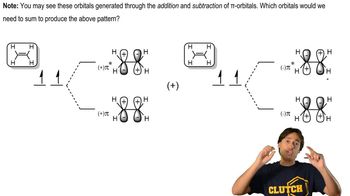
How are molecular orbitals sometimes described in textbooks for 4-atom conjugated systems?
They are sometimes described as the sum of two pi orbitals, such as positive pi and negative pi, or their antibonding counterparts.
What does the notation 'positive pi' refer to when drawing molecular orbitals?
Positive pi refers to the starting configuration where the dark lobes are facing down in the first orbital.
How is the antibonding version of a pi orbital denoted in this notation?
The antibonding version is denoted as pi star (π*), such as positive pi star or negative pi star.
How is Psi 1 represented using the sum of pi orbitals?
Psi 1 is represented as positive pi plus positive pi, meaning both lobes are in the same phase.
How is Psi 2 represented using the sum of pi orbitals?
Psi 2 is represented as positive pi plus negative pi, indicating a combination of opposite phases.
How is Psi 3 represented using the sum of pi orbitals?
Psi 3 is represented as positive pi star plus negative pi star, combining two antibonding orbitals of opposite phases.
Does the notation of summing pi orbitals provide additional insight into molecular orbital theory?
No, this notation does not provide extra insight; it is just a different way to represent the combinations of orbitals.