Organic Chemistry
My Course
Learn
Exam Prep
AI Tutor
Study Guides
Textbook Solutions
Flashcards
Explore
Try the app
My Course
Learn
Exam Prep
AI Tutor
Study Guides
Textbook Solutions
Flashcards
Explore
Try the app
Back
Orbital Diagram:4-atoms- 1,3-butadiene definitions
You can tap to flip the card.
Molecular Orbital Diagram
You can tap to flip the card.
👆
Molecular Orbital Diagram
A visual representation showing the energy and arrangement of orbitals formed from atomic orbitals in a molecule.
Track progress
Control buttons has been changed to "navigation" mode.
1/15
Related flashcards
Related practice
Recommended videos
Orbital Diagram:4-atoms- 1,3-butadiene quiz
Orbital Diagram:4-atoms- 1,3-butadiene
15 Terms
16. Conjugated Systems - Part 1 of 3
4 topics
15 problems
Chapter
Johnny
16. Conjugated Systems - Part 2 of 3
6 topics
14 problems
Chapter
Johnny
16. Conjugated Systems - Part 3 of 3
6 topics
14 problems
Chapter
Johnny
Guided course
06:20
Alternative MO Notation for Dienes
3
views
Guided course
04:43
Drawing MO Diagram for Dienes
2
views
Terms in this set (15)
Hide definitions
Molecular Orbital Diagram
A visual representation showing the energy and arrangement of orbitals formed from atomic orbitals in a molecule.
1,3-Butadiene
A four-carbon diene with two double bonds separated by a single bond, serving as a model for conjugated systems.
Diene
A hydrocarbon containing two double bonds, often used to illustrate conjugation in organic molecules.
Polyenes
Molecules with multiple alternating double and single bonds, allowing for extensive pi electron delocalization.
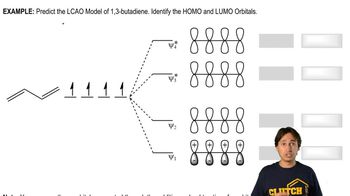
LCAO Model
A method combining atomic orbitals linearly to construct molecular orbitals for molecules like 1,3-butadiene.
HOMO
The highest energy molecular orbital that contains electrons, crucial for understanding chemical reactivity.
LUMO
The lowest energy molecular orbital that does not contain electrons, often involved in electron acceptance.
Node
A region in a molecular orbital where the probability of finding an electron is zero, increasing with orbital energy.
Phase
The sign or orientation of a wave function in an orbital, often depicted by shading or lobe direction.
Psi 1
The lowest energy molecular orbital in a four-atom conjugated system, with all lobes in the same phase.
Psi 2
A molecular orbital with one node, formed by combining orbitals with opposite phases in a four-atom system.
Psi 3
A higher energy molecular orbital with two nodes, resulting from antibonding combinations in a conjugated system.
Psi 4
The highest energy molecular orbital in a four-atom conjugated system, featuring three nodes and full phase alternation.
Frontier Orbitals
The pair of molecular orbitals (HOMO and LUMO) that play a key role in chemical reactions and electron transitions.
Antibonding Orbital
A molecular orbital formed by out-of-phase combinations of atomic orbitals, characterized by nodes and higher energy.