Back

Orbital Diagram:3-atoms- Allylic Ions quiz

Control buttons has been changed to "navigation" mode.
1/15
  • What is an allylic position in a 3-atom conjugated system?

    An allylic position is the atom next to a double bond in a conjugated system, often seen when there are an odd number of atoms.
  • How can the resonance of allylic positions be explained besides using resonance arrows?

    Resonance of allylic positions can be fundamentally explained using molecular orbital theory.
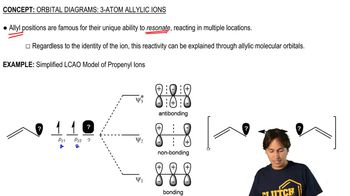
  • What is the simplified LCAO model used to demonstrate in the video?

    The simplified LCAO model is used to demonstrate molecular orbitals in a 3-atom conjugated system, such as a propanyl ion.
  • How are the atomic orbitals labeled in the 3-atom conjugated system example?

    The atomic orbitals are labeled as a, b, and c.
  • According to the Aufbau principle, which molecular orbital do the electrons from the double bond fill first?

    The electrons from the double bond fill the most stable bonding orbital, psi 1, first.
  • Where is the unknown ion or non-bonding orbital placed in the molecular orbital diagram?

    The unknown ion or non-bonding orbital at position C is placed into psi 2.
  • Does the identity of the ion at position C affect its placement in the molecular orbital diagram?

    No, regardless of whether it is empty, a radical, or a lone pair, it always goes into psi 2.
  • What is unique about psi 2 in the molecular orbital diagram for allylic ions?

    Psi 2 has a node at atom B, meaning no electrons are present at this position.
  • Why can't the allylic position react at atom B in the 3-atom system?

    Because psi 2 has a node at atom B, no electrons are present there, so no reaction can occur at this position.
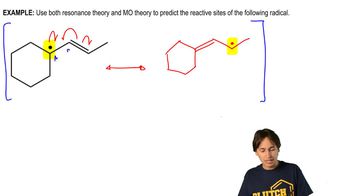
  • At which positions can the allylic ion react in the 3-atom conjugated system?

    The allylic ion can react at either position A or C, but never at B.
  • How does molecular orbital theory explain why resonance does not occur at the middle atom in allylic ions?

    Molecular orbital theory shows that the middle atom (B) has a node and no electrons, so resonance cannot occur there.
  • What does the molecular orbital diagram reveal about the behavior of allylic ions in resonance?

    It reveals that allylic ions can only react at positions with electrons, not at the node (middle atom).
  • Why can the positive charge in an allylic ion not move to the middle atom?

    Because the molecular orbital at the middle atom lacks electrons, the positive charge cannot resonate to that position.
  • What is the fundamental explanation for the reactive positions of an allylic ion?

    Molecular orbital theory explains that only orbitals with electrons (A or C) are reactive, not the node at B.
  • What is the significance of nodes in molecular orbital diagrams for conjugated systems?

    Nodes indicate positions where no electrons are present, thus preventing reactions at those atoms.