Back

Orbital Diagram:3-atoms- Allylic Ions definitions

Control buttons has been changed to "navigation" mode.
1/15
  • Allylic Position

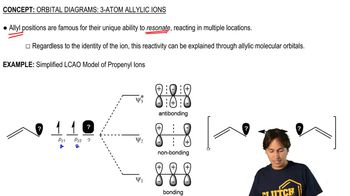
    Location adjacent to a double bond, capable of resonance and unique reactivity explained by molecular orbital theory.
  • Conjugated System

    Structure with alternating single and double bonds, allowing delocalization of electrons across three or more atoms.
  • Molecular Orbital Diagram

    Visual representation showing the arrangement and energy of molecular orbitals formed from atomic orbitals in a molecule.
  • Resonance

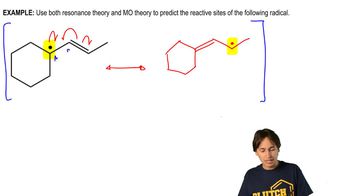
    Phenomenon where electrons are delocalized across multiple atoms, stabilizing the molecule by distributing charge.
  • LCAO Model

    Method combining atomic orbitals to form molecular orbitals, used to explain electron distribution in conjugated systems.
  • Propanyl Ion

    Three-atom system with a double bond and an ion at one end, used to illustrate allylic resonance and orbital interactions.
  • Atomic Orbital

    Region around an atom where electrons are likely found, labeled as a, b, and c in three-atom systems.
  • Bonding Orbital

    Lowest energy molecular orbital, filled first according to the Aufbau principle, stabilizing the molecule.
  • Psi 1

    Most stable molecular orbital with zero nodes, occupied by electrons from the double bond in a three-atom system.
  • Psi 2

    Molecular orbital with one node at the central atom, preventing electron density and reactivity at that position.
  • Node

    Location in a molecular orbital where electron probability is zero, influencing reactivity and resonance patterns.
  • Aufbau Principle

    Rule stating electrons fill the lowest energy orbitals first when constructing molecular orbital diagrams.
  • Non-bonding Orbital

    Orbital that does not contribute to bonding, often housing lone pairs, radicals, or empty sites in allylic ions.
  • Radical

    Species with an unpaired electron, which can occupy a non-bonding orbital in allylic systems.
  • Lone Pair

    Pair of valence electrons not involved in bonding, possibly occupying a non-bonding orbital in a three-atom system.