Skip to main content
Organic Chemistry
My Course
Learn
Exam Prep
AI Tutor
Study Guides
Textbook Solutions
Flashcards
Explore
Try the app
My Course
Learn
Exam Prep
AI Tutor
Study Guides
Textbook Solutions
Flashcards
Explore
Try the app
Back
Nucleophilic Catalysis quiz
You can tap to flip the card.
What is nucleophilic catalysis in organic chemistry?
You can tap to flip the card.
👆
What is nucleophilic catalysis in organic chemistry?
Nucleophilic catalysis involves replacing a leaving group with a better nucleophile, which enhances the reaction rate.
Track progress
Control buttons has been changed to "navigation" mode.
1/15
Related flashcards
Related practice
Recommended videos
Nucleophilic Catalysis definitions
Nucleophilic Catalysis
15 Terms
Nucleophilic Catalysis
31. Catalysis in Organic Reactions
5 problems
Topic
Metal Ion Catalysis
31. Catalysis in Organic Reactions
5 problems
Topic
31. Catalysis in Organic Reactions - Part 1 of 2
4 topics
12 problems
Chapter
31. Catalysis in Organic Reactions - Part 2 of 2
4 topics
12 problems
Chapter
Guided course
1:29
Nucleophilic Catalysis Example 1
6
views
Guided course
2:31
Nucleophilic Catalysis Concept 1
6
views
Guided course
1:52
Nucleophilic Catalysis Concept 2
4
views
Terms in this set (15)
Hide definitions
What is nucleophilic catalysis in organic chemistry?
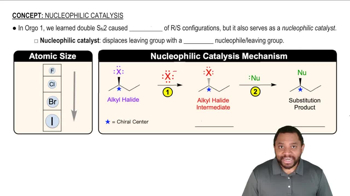
Nucleophilic catalysis involves replacing a leaving group with a better nucleophile, which enhances the reaction rate.
How does atomic size change as you move down group 7A (halogens) in the periodic table?
Atomic size increases as you move down group 7A, making iodine larger than bromine, chlorine, and fluorine.
Why is iodine considered a better leaving group than chlorine in nucleophilic catalysis?
Iodine is larger and lower in group 7A, making it a better nucleophile and leaving group than chlorine.
What happens to the configuration of a chiral center during a double SN2 mechanism?
Double SN2 causes two inversions, resulting in retention of the original R or S configuration.
What is the effect of replacing a halogen with a larger halogen in nucleophilic catalysis?
Replacing with a larger halogen increases the rate of the subsequent nucleophilic substitution reaction.
How does the SN2 mechanism affect the configuration of a chiral center?
A single SN2 causes inversion of configuration, flipping the bond from wedged to dashed or vice versa.
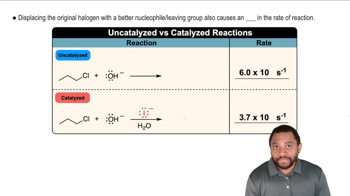
What is the rate of the uncatalyzed reaction for propyl chloride with hydroxide ion?
The uncatalyzed reaction rate is 6.0 x 10^-3 seconds^-1.
What is the rate of the catalyzed reaction for propyl chloride when iodine is used?
The catalyzed reaction rate is 3.7 x 10^6 seconds^-1.
How does nucleophilic catalysis affect the speed of a reaction compared to an uncatalyzed reaction?
Nucleophilic catalysis increases the reaction rate by several orders of magnitude.
What product is formed when propyl chloride reacts with hydroxide ion via SN2?
The product is 1-propanol.
Why does the second SN2 reaction occur faster when iodine replaces chlorine as the leaving group?
Iodine is a better leaving group, so the nucleophile can displace it more quickly.
What is the significance of double SN2 in nucleophilic catalysis?
Double SN2 not only retains configuration but also catalyzes the reaction, making it faster.
What is the general trend for nucleophilicity and leaving group ability among halogens?
Both nucleophilicity and leaving group ability increase as you move down the halogen group.
How does the bond orientation change after two SN2 reactions at a chiral center?
The bond orientation returns to its original state, showing retention after two inversions.
What is the main advantage of using a better leaving group in nucleophilic substitution reactions?
A better leaving group allows the reaction to proceed much faster, increasing efficiency.
 BackBack
 1:29
1:29