Skip to main content
Organic Chemistry
My Course
Learn
Exam Prep
AI Tutor
Study Guides
Textbook Solutions
Flashcards
Explore
Try the app
My Course
Learn
Exam Prep
AI Tutor
Study Guides
Textbook Solutions
Flashcards
Explore
Try the app
Back
Nucleophilic Catalysis definitions
You can tap to flip the card.
Nucleophilic Catalysis
You can tap to flip the card.
👆
Nucleophilic Catalysis
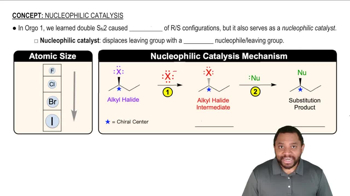
Acceleration of a substitution reaction by introducing a more effective nucleophile, leading to faster displacement of a leaving group.
Track progress
Control buttons has been changed to "navigation" mode.
1/15
Related flashcards
Related practice
Recommended videos
Nucleophilic Catalysis quiz
Nucleophilic Catalysis
15 Terms
Nucleophilic Catalysis
31. Catalysis in Organic Reactions
5 problems
Topic
Metal Ion Catalysis
31. Catalysis in Organic Reactions
5 problems
Topic
31. Catalysis in Organic Reactions - Part 1 of 2
4 topics
12 problems
Chapter
31. Catalysis in Organic Reactions - Part 2 of 2
4 topics
12 problems
Chapter
1:29
Nucleophilic Catalysis Example 1
3
views
2:31
Nucleophilic Catalysis Concept 1
4
views
1:52
Nucleophilic Catalysis Concept 2
3
views
Terms in this set (15)
Hide definitions
Nucleophilic Catalysis
Acceleration of a substitution reaction by introducing a more effective nucleophile, leading to faster displacement of a leaving group.
Double SN2 Mechanism
Two consecutive backside attacks causing two inversions, ultimately resulting in retention of the original stereochemistry.
Retention of Configuration
Outcome where the spatial arrangement around a chiral center remains unchanged after two sequential inversions.
Inversion of Configuration
Switch in the spatial arrangement at a chiral center, typically observed in a single SN2 reaction.
Chiral Center
Carbon atom bonded to four distinct groups, leading to non-superimposable mirror images.
Alkyl Halide
Organic compound containing a halogen atom attached to an alkyl group, often serving as a substrate in substitution reactions.
Leaving Group
Atom or group that departs with a pair of electrons during a substitution, with effectiveness increasing down group 7A.
Nucleophile
Species with a lone pair or negative charge that seeks out electron-deficient centers to form new bonds.
Halogen
Element from group 7A, such as chlorine or iodine, whose size and ability as a leaving group increase down the group.
Reaction Rate
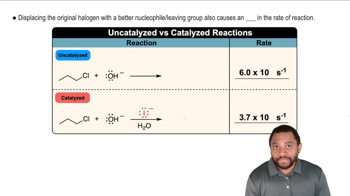
Speed at which reactants convert to products, significantly enhanced by better leaving groups in catalyzed reactions.
Primary Alkyl Halide
Halogenated compound where the halogen is attached to a carbon bonded to only one other carbon.
Hydroxide Ion
Strong nucleophile, often used to displace halogens in SN2 reactions, leading to alcohol formation.
Propyl Chloride
A primary alkyl halide used as a substrate in nucleophilic catalysis examples, specifically 1-chloropropane.
Iodine
Large halogen that acts as a superior leaving group and nucleophile, greatly increasing substitution reaction rates.
Stereochemistry
Study of spatial arrangements of atoms in molecules, crucial for understanding outcomes of SN2 reactions.
 BackBack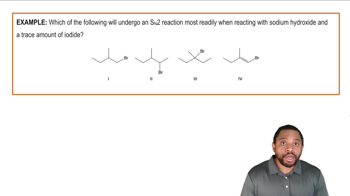
 1:29
1:29