Back

Nucleophilic Aromatic Substitution definitions

Control buttons has been changed to "navigation" mode.
1/14
  • Nucleophilic Aromatic Substitution

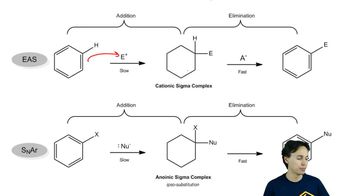
    A benzene reaction where a strong nucleophile replaces a leaving group via a two-step addition-elimination pathway.
  • Electrophilic Aromatic Substitution

    A benzene reaction initiated by an electrophile, forming a cationic sigma complex before substitution occurs.
  • Leaving Group

    An atom or group on benzene that departs during substitution, enabling nucleophilic attack and intermediate formation.
  • Sigma Complex

    A charged intermediate formed during aromatic substitution, with charge delocalized over several ring atoms.
  • Anionic Intermediate

    A negatively charged species formed after nucleophilic attack on benzene, often unstable without stabilization.
  • Dow Process

    An industrial method converting chlorobenzene to phenol using NaOH at high temperature and pressure via SNAr.
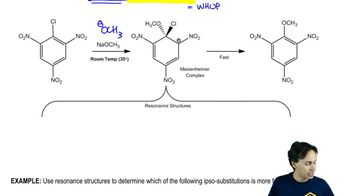
  • Meisenheimer Complex

    A stabilized anionic intermediate in SNAr, enhanced by electron-withdrawing groups or heteroatoms at ortho/para positions.
  • Electron-Withdrawing Group

    A substituent that stabilizes negative charge in SNAr intermediates by delocalizing electrons through resonance or induction.
  • Heteroatom

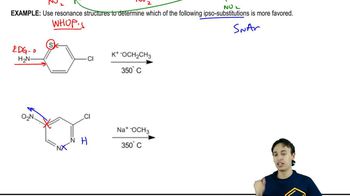
    A non-carbon atom within the aromatic ring, such as nitrogen, that aids in stabilizing negative charge during SNAr.
  • Resonance Structure

    A depiction showing delocalization of electrons within intermediates, crucial for understanding charge stabilization in SNAr.
  • Ipso Substitution

    A process where two groups temporarily share a carbon during aromatic substitution, synonymous with SNAr.
  • Phenol

    A product of the Dow process, formed when a hydroxyl group replaces a leaving group on benzene.
  • Phenoxide

    The deprotonated form of phenol, often generated under basic SNAr conditions before acid workup.
  • Addition-Elimination Mechanism

    A two-step process in SNAr where nucleophilic addition forms an intermediate, followed by elimination of the leaving group.