Back

Non-Carbon Chiral Centers quiz

Control buttons has been changed to "navigation" mode.
1/15
  • Which non-carbon atoms can serve as chiral centers if they form four different bonds?

    Silicon, nitrogen, phosphorus, and sulfur can serve as chiral centers if they form four different bonds to distinct atoms.
  • Why is a neutral amine (nitrogen with a lone pair) generally not chiral?

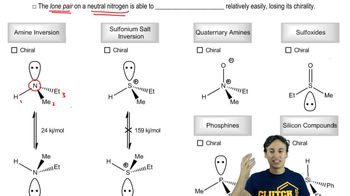
    A neutral amine is not chiral because the lone pair can undergo amine inversion, switching positions easily and not maintaining a fixed configuration.
  • What is amine inversion and why does it prevent chirality in neutral amines?

    Amine inversion is the process where the lone pair on nitrogen flips positions, making it impossible to maintain a fixed spatial arrangement and thus preventing chirality.
  • Why are sulfonium salts considered chiral?

    Sulfonium salts are chiral because the energy required for the lone pair to invert is very high, so the spatial arrangement remains fixed under normal conditions.
  • What type of nitrogen compound can be chiral and why?

    A quaternary ammonium ion (nitrogen with four different groups and a positive charge) can be chiral because it cannot undergo inversion like neutral amines.
  • How does the energy barrier for inversion affect the chirality of sulfur and phosphorus compounds?

    A high energy barrier for inversion in sulfur and phosphorus compounds means their configurations are stable, allowing them to be chiral.
  • What is a sulfoxide and why can it be chiral?

    A sulfoxide is a sulfur atom bonded to two R groups, a double-bonded oxygen, and a lone pair; it can be chiral because the lone pair does not invert easily.
  • Why are phosphines often chiral?

    Phosphines are often chiral because the inversion of the lone pair is difficult due to a high energy barrier, so their configuration remains fixed.
  • How is silicon similar to carbon in terms of chirality?

    Silicon is similar to carbon because it can form four bonds to different groups, making it capable of being a chiral center.
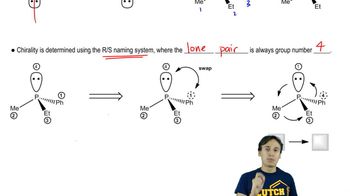
  • When assigning R and S configuration to non-carbon chiral centers, what priority is given to the lone pair?

    The lone pair is always assigned the lowest priority (group number four) when determining R and S configuration.
  • What is the first step in assigning R and S configuration to a non-carbon chiral center?

    The first step is to assign priorities to the groups attached to the chiral center based on atomic number, with the lone pair as the lowest priority.
  • What must you do with the lowest priority group when determining R and S configuration?

    You must position the lowest priority group (the lone pair) at the back before analyzing the spatial arrangement of the other groups.
  • How do you handle a situation where the lowest priority group is not at the back when assigning R and S?

    If the lowest priority group is not at the back, you swap it with the group that is, and then reverse the R/S assignment at the end.
  • Why does a lone pair have lower priority than hydrogen in R/S assignments?

    A lone pair has lower priority than hydrogen because it is not an atom, just electrons, making it the lowest priority group.
  • What is the general rule for determining if a non-carbon atom can be a chiral center?

    A non-carbon atom can be a chiral center if it forms four different bonds to four distinct groups and its configuration is stable (not easily inverted).