Back

Non-Carbon Chiral Centers definitions

Control buttons has been changed to "navigation" mode.
1/14
  • Chirality

    A property where an atom forms four distinct bonds, resulting in non-superimposable mirror images.
  • Chiral Center

    An atom bonded to four different groups, creating a molecule with non-superimposable mirror images.
  • Silicon

    An element analogous to carbon, capable of serving as a chiral center when bonded to four distinct groups.
  • Nitrogen

    An element that can be a chiral center only when it forms four bonds, typically carrying a positive charge.
  • Phosphorus

    An element that can act as a chiral center due to its high inversion energy, maintaining fixed spatial arrangement.
  • Sulfur

    An element that can be chiral in certain compounds, especially when inversion of its lone pair is energetically unfavorable.
  • Amine Inversion

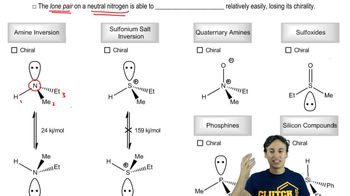
    A rapid process where a lone pair on neutral nitrogen flips position, preventing stable chirality.
  • Sulfonium Salt

    A positively charged sulfur species with a lone pair, exhibiting chirality due to high inversion energy.
  • Quaternary Ammonium

    A nitrogen atom with four different substituents and a positive charge, serving as a chiral center.
  • Sulfoxide

    A sulfur compound with two organic groups, a double-bonded oxygen, and a lone pair, capable of being chiral.
  • Phosphine

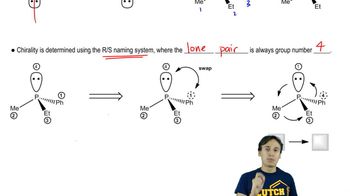
    A phosphorus compound with three organic groups and a lone pair, often chiral due to resistance to inversion.
  • Inversion Energy

    The energy required for a lone pair to switch positions, determining whether chirality is maintained.
  • Lone Pair

    A pair of non-bonding electrons on an atom, often assigned lowest priority in R/S configuration.
  • R and S Configuration

    A system for naming chiral centers by prioritizing groups and assigning spatial arrangement as R or S.