Organic Chemistry
My Course
Learn
Exam Prep
AI Tutor
Study Guides
Textbook Solutions
Flashcards
Explore
Try the app
My Course
Learn
Exam Prep
AI Tutor
Study Guides
Textbook Solutions
Flashcards
Explore
Try the app
Back
Nitrile to Ketone quiz
You can tap to flip the card.
What type of reagents are commonly used to convert nitriles into ketones?
You can tap to flip the card.
👆
What type of reagents are commonly used to convert nitriles into ketones?
Organometallic reagents such as Grignard reagents (e.g., CH3MgBr) and organolithium reagents are commonly used.
Track progress
Control buttons has been changed to "navigation" mode.
1/15
Related flashcards
Related practice
Recommended videos
Nitrile to Ketone definitions
Nitrile to Ketone
15 Terms
19. Aldehydes and Ketones:Nucleophilic Addition - Part 1 of 3
5 topics
14 problems
Chapter
Johnny
19. Aldehydes and Ketones:Nucleophilic Addition - Part 2 of 3
1 topic
13 problems
Chapter
Johnny
19. Aldehydes and Ketones:Nucleophilic Addition - Part 3 of 3
2 topics
13 problems
Chapter
Ernest
Guided course
07:25
Mechanism
1
views
Guided course
01:38
General Reaction
1
views
Terms in this set (15)
Hide definitions
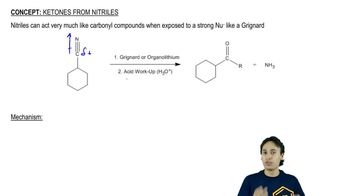
What type of reagents are commonly used to convert nitriles into ketones?
Organometallic reagents such as Grignard reagents (e.g., CH3MgBr) and organolithium reagents are commonly used.
Why is the carbon in a nitrile highly electrophilic?
The strong dipole along the carbon-nitrogen bond makes the carbon highly electrophilic, similar to carbonyls.
What is the first step when reacting a nitrile with a Grignard reagent?
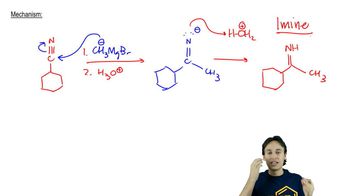
The nucleophilic Grignard reagent attacks the electrophilic carbon of the nitrile, forming an intermediate with a negatively charged nitrogen.
What functional group is formed after the nucleophilic addition of a Grignard reagent to a nitrile?
An imine intermediate is formed, which has a nitrogen with a negative charge.
What is the purpose of the acid workup in the nitrile to ketone conversion?
The acid workup protonates the nitrogen and facilitates the conversion of the imine intermediate into a ketone.
What happens to the nitrogen atom during the acid workup step?
The nitrogen is protonated, then eliminated as NH3 (ammonia), allowing the formation of the ketone.
How is the mechanism for converting an imine to a ketone related to imine formation?
It is essentially the reverse of the imine formation mechanism.
What is the role of water during the acid workup?
Water acts as a nucleophile, attacking the imine carbon and helping to convert the imine into a ketone.
What is eliminated as a leaving group during the acid workup?
Ammonia (NH3) is eliminated as the leaving group.
Why is it important to understand the imine mechanism when learning about nitrile to ketone conversion?
Because the acid workup step is the reverse of the imine formation mechanism, understanding one helps with the other.
What does the R group in the final ketone product come from?
The R group comes from the Grignard or organolithium reagent used in the reaction.
Is it always necessary to draw the full acid workup mechanism on exams?
Not always; many professors accept just writing 'acid workup,' but students should confirm with their instructor.
What is the general outcome when a nitrile reacts with a Grignard reagent followed by acid workup?
A ketone is formed, with the R group from the Grignard reagent attached to the carbonyl carbon.
What is the significance of the term 'acid workup' in organic synthesis?
Acid workup typically refers to the hydrolysis of a nitrogen group (like an imine) into an oxygen group (like a ketone).
What advice does the instructor give regarding learning mechanisms for this reaction?
Students should be proactive in asking their professors about expectations for drawing mechanisms and should understand the underlying concepts.