Organic Chemistry
My Course
Learn
Exam Prep
AI Tutor
Study Guides
Textbook Solutions
Flashcards
Explore
Try the app
My Course
Learn
Exam Prep
AI Tutor
Study Guides
Textbook Solutions
Flashcards
Explore
Try the app
Back
Nitrile to Ketone definitions
You can tap to flip the card.
Nitrile
You can tap to flip the card.
👆
Nitrile
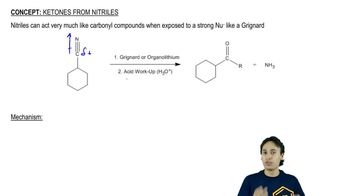
A functional group featuring a carbon triple-bonded to nitrogen, making the carbon highly electrophilic and reactive toward nucleophiles.
Track progress
Control buttons has been changed to "navigation" mode.
1/15
Related flashcards
Related practice
Recommended videos
Nitrile to Ketone quiz
Nitrile to Ketone
15 Terms
19. Aldehydes and Ketones:Nucleophilic Addition - Part 1 of 3
5 topics
14 problems
Chapter
Johnny
19. Aldehydes and Ketones:Nucleophilic Addition - Part 2 of 3
1 topic
13 problems
Chapter
Johnny
19. Aldehydes and Ketones:Nucleophilic Addition - Part 3 of 3
2 topics
13 problems
Chapter
Ernest
Guided course
07:25
Mechanism
1
views
Guided course
01:38
General Reaction
1
views
Terms in this set (15)
Hide definitions
Nitrile
A functional group featuring a carbon triple-bonded to nitrogen, making the carbon highly electrophilic and reactive toward nucleophiles.
Ketone
A carbonyl-containing compound where the carbonyl carbon is bonded to two alkyl or aryl groups, formed after acid workup of a nitrile.
Grignard Reagent
An organometallic compound with a carbon-magnesium bond, acting as a strong nucleophile to add alkyl groups to electrophilic carbons.
Organolithium Reagent
A highly reactive organometallic compound with a carbon-lithium bond, used to introduce alkyl groups via nucleophilic addition.
Nucleophilic Addition
A reaction where a nucleophile attacks an electrophilic carbon, commonly seen when organometallics react with nitriles.
Electrophilic Carbon
A carbon atom with a partial positive charge, making it susceptible to attack by nucleophiles, as seen in nitriles.
Acid Workup
A sequence involving protonation, water addition, and elimination steps, converting intermediates into stable products like ketones.
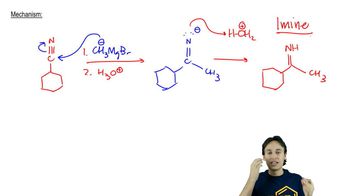
Imine
An intermediate with a carbon-nitrogen double bond, formed after nucleophilic addition to a nitrile and before conversion to a ketone.
Protonation
The addition of a proton to a molecule, often used to activate intermediates for further transformation during acid workup.
Resonance Structure
A different way of drawing the same molecule, showing delocalization of electrons, often used to depict charged intermediates.
Leaving Group
An atom or group that departs with a pair of electrons during a reaction, such as NH3 in the conversion of imine to ketone.
Proton Transfer
A step where a proton moves from one atom to another, facilitating the transformation of intermediates during acid workup.
Elimination
A reaction step where a group is expelled from a molecule, often forming a double bond, as seen when NH3 leaves to form a ketone.
Hydrolysis
A reaction involving water to break chemical bonds, crucial in converting imine intermediates to ketones during acid workup.
Carbonyl
A functional group with a carbon double-bonded to oxygen, present in ketones and formed after the acid workup of a nitrile.