Back

Naming Carboxylic Acids definitions

Control buttons has been changed to "navigation" mode.
1/14
  • Carboxylic Acid

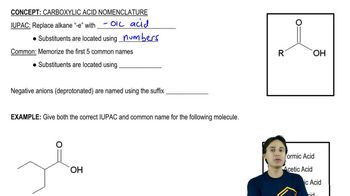
    An organic compound featuring a carbonyl and hydroxyl group bonded to the same carbon, known for acidic properties.
  • IUPAC System

    A standardized method for naming organic compounds, using systematic rules and suffixes to indicate structure.
  • Common Name System

    A traditional naming approach based on historical or trivial names, often unrelated to structure.
  • Suffix

    A word ending added to a root name to indicate functional groups or chemical modifications in nomenclature.
  • Substituent

    An atom or group of atoms attached to the main carbon chain, identified by position in systematic naming.
  • Greek Letters

    Symbols like alpha, beta, gamma, used in common naming to indicate positions of groups relative to a functional group.
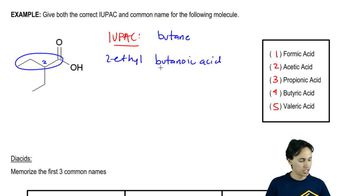
  • Formic Acid

    The simplest carboxylic acid, containing one carbon, commonly found in ant venom.
  • Acetic Acid

    A two-carbon carboxylic acid, widely recognized as the main component of vinegar.
  • Propionic Acid

    A three-carbon carboxylic acid, known for its presence in some dairy products.
  • Butyric Acid

    A four-carbon carboxylic acid, notable for its strong odor and occurrence in rancid butter.
  • Valeric Acid

    A five-carbon carboxylic acid, less common but part of the first five acids to memorize.
  • Anion

    A negatively charged species formed when a carboxylic acid loses a proton, often ending with 'ate.'
  • Benzoic Acid

    An aromatic carboxylic acid, commonly used as a food preservative and referenced in systematic naming.
  • Alkane Root

    The base hydrocarbon chain name used as the foundation for systematic naming of derivatives.