Back

Monosaccharides - Weak Oxidation (Aldonic Acid) quiz

Control buttons has been changed to "navigation" mode.
1/15
  • What functional group is formed when monosaccharide aldehydes undergo weak oxidation?

    Aldonic acids are formed when monosaccharide aldehydes are oxidized to carboxylic acids.
  • Which reagent is commonly used for the weak oxidation of monosaccharides?

    Bromine water, typically in a mildly acidic solution, is used for weak oxidation.
  • Does weak oxidation affect ketoses in monosaccharides?

    No, weak oxidation does not work on ketoses because they lack aldehyde groups.
  • What is the main functional group in monosaccharides that undergoes weak oxidation?

    The aldehyde group is selectively oxidized to a carboxylic acid.
  • How does weak oxidation help differentiate between aldoses and ketoses?

    Weak oxidation only works on aldoses, not ketoses, making it useful for distinguishing them.
  • What happens to the other functional groups in a monosaccharide during weak oxidation?

    Other groups, such as primary alcohols, remain unchanged during weak oxidation.
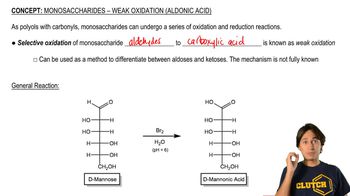
  • What is the naming convention for the product of weak oxidation of D-mannose?

    The product is named D-mannonic acid, adding 'onic acid' to the root name.
  • Is the mechanism of weak oxidation of monosaccharides fully understood?

    No, the mechanism is not fully known and students are not required to draw it.
  • What is the principle behind using weak oxidation in sugar tests?

    Weak oxidation is used to test for the presence of aldehyde groups in sugars.
  • What is the effect of bromine water on D-mannose?

    Bromine water selectively oxidizes the aldehyde group of D-mannose to form D-mannonic acid.
  • What suffix is added to the root name of a monosaccharide after weak oxidation?

    The suffix 'onic acid' is added to the root name.
  • Why is weak oxidation considered selective?

    It only oxidizes the aldehyde group without affecting other functional groups.
  • What is the starting material for the formation of aldonic acids via weak oxidation?

    Aldoses, which contain an aldehyde group, are the starting materials.
  • What happens to the primary alcohol group during weak oxidation?

    The primary alcohol group remains unchanged during weak oxidation.
  • What is the product called when D-mannose is oxidized at the aldehyde position?

    The product is called D-mannonic acid, an aldonic acid derivative of D-mannose.