Back

Monosaccharides - Weak Oxidation (Aldonic Acid) definitions

Control buttons has been changed to "navigation" mode.
1/14
  • Monosaccharide

    A polyhydroxy compound with a single carbonyl group, serving as the simplest form of carbohydrate.
  • Aldehyde

    A terminal carbonyl functional group in sugars, selectively oxidized during weak oxidation.
  • Carboxylic Acid

    A functional group formed when an aldehyde in a sugar is oxidized under mild conditions.
  • Aldonic Acid

    A modified sugar produced by oxidizing only the aldehyde group of an aldose to a carboxylic acid.
  • Aldose

    A sugar containing an aldehyde group, making it reactive in weak oxidation with bromine water.
  • Ketose

    A sugar with a ketone group, unreactive in weak oxidation with bromine water.
  • Bromine Water

    A reagent in mildly acidic solution used to selectively oxidize aldehydes in sugars.
  • Oxidation

    A chemical process where electrons are lost, converting aldehydes in sugars to carboxylic acids.
  • Reduction

    A chemical process involving electron gain, often affecting carbonyl groups in sugars.
  • Primary Alcohol

    A hydroxyl group attached to a terminal carbon, remaining unchanged during weak oxidation.
  • Functional Group

    A specific group of atoms within a molecule responsible for characteristic chemical reactions.
  • Suffix

    A naming convention added to the root of a monosaccharide to indicate formation of an aldonic acid.
  • D-Mannose

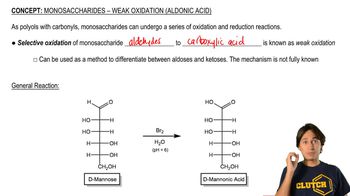
    A specific aldose sugar that can be converted to D-mannonic acid via weak oxidation.
  • D-Mannonic Acid

    The product formed when D-mannose undergoes selective oxidation of its aldehyde group.