Back

Monosaccharides - Strong Oxidation (Aldaric Acid) quiz

Control buttons has been changed to "navigation" mode.
1/15
  • What reagent is used for the strong oxidation of monosaccharides to produce aldaric acids?

    Aqueous nitric acid is used for the strong oxidation of monosaccharides to produce aldaric acids.
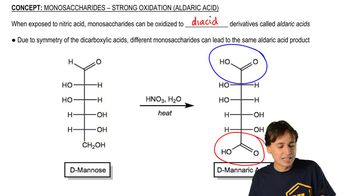
  • What functional groups are formed at both ends of a monosaccharide after strong oxidation with nitric acid?

    Both the top aldehyde and the bottom alcohol are converted into carboxylic acids, forming a diacid.
  • What is the product called when both ends of a monosaccharide are oxidized to carboxylic acids?

    The product is called an aldaric acid, which is a dicarboxylic acid.
  • How does strong oxidation differ from weak oxidation of monosaccharides?

    Strong oxidation converts both the top aldehyde and bottom alcohol to carboxylic acids, while weak oxidation only converts the top aldehyde.
  • What is the main reagent for weak oxidation of monosaccharides?

    Bromine water is used for the weak oxidation of monosaccharides.
  • What is the name of the acid formed by weak oxidation of a monosaccharide?

    The acid formed is called an aldonic acid.
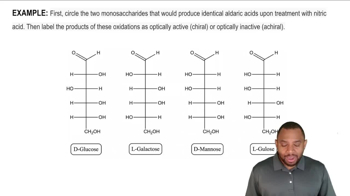
  • Why might different monosaccharides yield the same aldaric acid after strong oxidation?

    Because the resulting aldaric acid is symmetrical, different monosaccharides can produce the same product if their structures become identical upon oxidation.
  • Is heat always required for the strong oxidation of monosaccharides with nitric acid?

    Heat is often used but not absolutely essential; the reaction can occur without it.
  • What does the term 'diacid' refer to in the context of monosaccharide oxidation?

    'Diacid' refers to a molecule with two carboxylic acid groups, one at each end.
  • What structural feature makes aldaric acids symmetrical?

    Both ends of the molecule have identical carboxylic acid groups, creating symmetry.
  • What is the difference in the number of carboxylic acid groups between aldonic and aldaric acids?

    Aldonic acids have one carboxylic acid group, while aldaric acids have two.
  • Why is it suggested to use flashcards for the names aldonic acid and aldaric acid?

    Because the names are similar and can be confusing, flashcards help in memorizing their differences.
  • What happens to the bottom alcohol group during strong oxidation of a monosaccharide?

    The bottom alcohol group is oxidized to a carboxylic acid.
  • Can two different monosaccharides ever produce the same aldaric acid? Why or why not?

    Yes, because after oxidation, the symmetry of the molecule can make their structures identical.
  • What is the key identifying feature of an aldaric acid compared to its parent monosaccharide?

    An aldaric acid has carboxylic acid groups at both the top and bottom of the molecule.