Back

Monosaccharides - Strong Oxidation (Aldaric Acid) definitions

Control buttons has been changed to "navigation" mode.
1/13
  • Monosaccharide

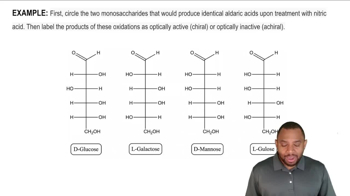
    A simple sugar molecule that can undergo oxidation reactions to form various acid derivatives.
  • Strong Oxidation

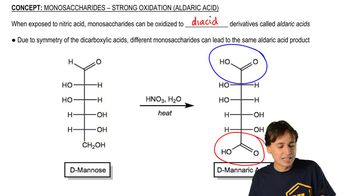
    A chemical process converting both the terminal aldehyde and primary alcohol of a sugar into carboxylic acids.
  • Nitric Acid

    Aqueous reagent used to achieve strong oxidation of sugars, transforming both ends into carboxylic acids.
  • Aldaric Acid

    A diacid product formed when both the top and bottom groups of a monosaccharide become carboxylic acids.
  • Aldonic Acid

    A sugar acid formed by oxidizing only the aldehyde group at the top of a monosaccharide.
  • Diacid

    A molecule containing two carboxylic acid groups, often resulting from strong oxidation of sugars.
  • Carboxylic Acid

    A functional group characterized by a carbon double-bonded to oxygen and single-bonded to a hydroxyl group.
  • Symmetry

    A property where the top and bottom functional groups of a molecule are identical after strong oxidation.
  • Reagent

    A substance, such as nitric acid, used to bring about a chemical transformation in a reaction.
  • Functional Group

    A specific group of atoms within a molecule responsible for characteristic chemical reactions.
  • Alcohol

    A functional group in sugars that can be oxidized to a carboxylic acid during strong oxidation.
  • Heat

    A condition sometimes applied to increase the rate of strong oxidation, though not always essential.
  • Derivative

    A compound resulting from the chemical modification of a parent molecule, such as a sugar acid from a monosaccharide.