Back

Metal Ion Catalysis quiz

Control buttons has been changed to "navigation" mode.
1/15
  • What charges do metal ions typically have in metal ion catalysis?

    Metal ions typically have a 2+ or 3+ charge in metal ion catalysis.
  • How do metal ions enhance the rate of reaction in catalysis?

    They enhance the rate by metal ion coordination and water activation.
  • What is the role of metal ion coordination in catalysis?

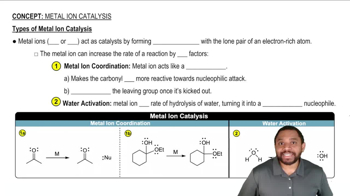
    Metal ion coordination increases the reactivity of carbonyl carbons towards nucleophilic attack and stabilizes leaving groups.
  • How does a metal ion make a carbonyl carbon more reactive?

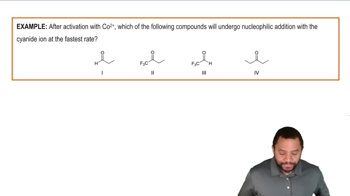
    By coordinating with the carbonyl oxygen, the metal ion makes the carbonyl carbon more susceptible to nucleophilic attack.
  • What effect does metal ion coordination have on leaving groups?

    It stabilizes the leaving group, making it easier for the group to leave during the reaction.
  • How does a metal ion act similarly to a proton in catalysis?

    The metal ion acts like a proton by forming a bond with an electron-rich atom, increasing its partial positive character.
  • What is water activation in the context of metal ion catalysis?

    Water activation is when a metal ion increases the nucleophilicity of water by forming a metal hydroxide complex.
  • Why is water activation important under physiological pH?

    At physiological pH, free hydroxide ions are scarce, so water activation allows the formation of a more nucleophilic metal hydroxide complex.
  • What type of reactions can the metal hydroxide complex participate in?

    The metal hydroxide complex can participate in nucleophilic addition and nucleophilic substitution reactions.
  • Why is the metal hydroxide complex more nucleophilic than water?

    Because the metal ion increases the electron density on the hydroxide, making it a stronger nucleophile than water.
  • What is the significance of metal ion catalysis in biological systems?

    It allows efficient catalytic reactions under physiological conditions where strong nucleophiles like hydroxide are not available.
  • How does the metal ion stabilize the leaving group in a reaction?

    By coordinating with the leaving group, the metal ion increases its partial positive charge, making it a better leaving group.
  • What happens to the oxygen atom when it coordinates with a metal ion?

    The oxygen atom becomes partially positive due to its interaction with the partially positive metal ion.
  • What are the two main mechanisms by which metal ions catalyze reactions?

    The two main mechanisms are metal ion coordination and water activation.
  • Why can't free hydroxide ions be used in biological systems for catalysis?

    Because physiological pH is neutral, free hydroxide ions are not present in significant amounts, so metal-activated water is used instead.