Back

Metal Ion Catalysis definitions

Control buttons has been changed to "navigation" mode.
1/15
  • Metal Ion Catalysis

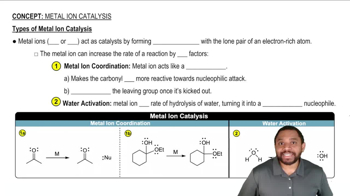
    A process where charged metals enhance reaction rates by forming complexes that activate substrates or water molecules.
  • Coordination

    A metal forms a bond with an electron-rich atom, increasing substrate reactivity or stabilizing leaving groups during reactions.
  • Water Activation

    Conversion of water into a more reactive nucleophile via interaction with a metal, enabling efficient hydrolysis under mild conditions.
  • Carbonyl Carbon

    An atom in a carbonyl group whose reactivity toward nucleophiles is increased by metal complexation.
  • Nucleophile

    A species that donates an electron pair to form a new bond, often attacking activated carbons in catalyzed reactions.
  • Leaving Group

    An atom or group that departs with a pair of electrons during a reaction, its stability enhanced by metal coordination.
  • Hydrolysis

    A reaction involving water splitting into ions, with its rate increased by metal ions forming reactive complexes.
  • Metal Hydroxide Complex

    A structure where a metal ion is bonded to hydroxide, creating a potent nucleophile under physiological conditions.
  • Physiological pH

    A near-neutral environment, around 7.4, where metal-catalyzed water activation is crucial due to low hydroxide availability.
  • Nucleophilic Addition

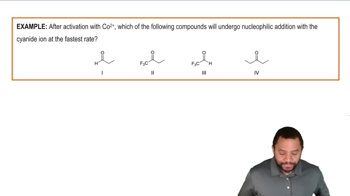
    A reaction where a nucleophile forms a bond with an activated carbon, often facilitated by metal ion catalysis.
  • Nucleophilic Substitution

    A process where a nucleophile replaces a leaving group, with metal ions enhancing the reactivity of the substrate.
  • Electron-rich Atom

    An atom with lone pairs that can coordinate with metals, increasing the atom's reactivity in catalyzed reactions.
  • Partially Positive Charge

    A slight positive character developed on atoms or metals upon coordination, influencing reactivity and stability.
  • Catalyst

    A substance, often a metal ion, that increases reaction rates without being consumed, typically by activating reactants.
  • Complex

    An assembly formed when a metal ion binds to other atoms or molecules, altering their chemical properties.