Back

Metal Ion Catalysis: Water Activation quiz

Control buttons has been changed to "navigation" mode.
1/15
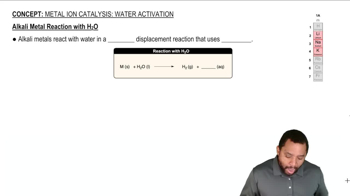
  • What is the general reaction when an alkali metal reacts with water?

    The reaction produces hydrogen gas and a metal hydroxide (MOH).
  • Which group of metals are considered alkali metals?

    Alkali metals are group 1A metals, including lithium, sodium, and potassium.
  • What is the charge of alkali metals and hydroxide ions in the reaction with water?

    Alkali metals have a +1 charge, and hydroxide ions have a -1 charge.
  • What are the products formed when sodium reacts with water?

    The products are hydrogen gas and sodium hydroxide (NaOH).
  • What type of reaction occurs between alkali metals and water?

    A single displacement reaction occurs, producing hydrogen gas and metal hydroxide.
  • How do metal hydroxide complexes catalyze hydrolysis reactions?

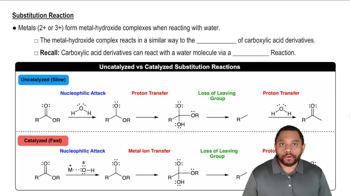
    They enhance reaction rates by facilitating nucleophilic acyl substitution mechanisms.
  • What is the similarity between metal ion catalysis and ester hydrolysis?

    Both involve nucleophilic attack on a carbonyl carbon, leading to hydrolysis.
  • What happens to the rate of hydrolysis when water is activated by a metal ion?

    The rate increases because the reaction is catalyzed.
  • What is the role of the metal ion in the activated water molecule during hydrolysis?

    The metal ion substitutes for a hydrogen, forming a metal hydroxide complex.
  • How does the mechanism of metal ion-catalyzed hydrolysis differ from uncatalyzed hydrolysis?

    The mechanism is similar, but a metal ion replaces a hydrogen, and the reaction is faster.
  • What is the final product after hydrolysis of an ester with activated water?

    The final product is a carboxylic acid, which can be further deprotonated to a carboxylate anion.
  • What is the function of the metal ion during the nucleophilic acyl substitution mechanism?

    The metal ion can transfer to the leaving group, making it a better leaving group.
  • What happens to the oxygen atom during nucleophilic attack in ester hydrolysis?

    The oxygen becomes negatively charged after the pi bond is pushed up.
  • What is the significance of the dotted bond between the metal and hydroxide oxygen in the mechanism?

    It represents the interaction between the metal ion and the hydroxide, facilitating activation.
  • How does the metal ion behave in the mechanism compared to a proton?

    The metal ion can behave like a proton, transferring to the leaving group to aid its departure.