Back

Metal Ion Catalysis: Water Activation definitions

Control buttons has been changed to "navigation" mode.
1/15
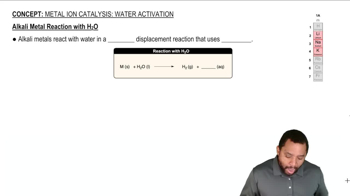
  • Alkali Metal

    Group 1A element, such as lithium, sodium, or potassium, that reacts vigorously with water to produce hydrogen gas and a metal hydroxide.
  • Single Displacement Reaction

    Chemical process where an element replaces another in a compound, as seen when alkali metals react with water.
  • Hydrogen Gas

    Gaseous product formed when alkali metals react with water, often observed as bubbling or effervescence.
  • Metal Hydroxide

    Ionic compound formed when an alkali metal reacts with water, consisting of a metal cation and hydroxide anion.
  • Carboxylic Acid Derivative

    Compound related to carboxylic acids, such as esters, that can undergo hydrolysis to yield carboxylic acids.
  • Hydrolysis

    Reaction involving water that breaks chemical bonds, converting carboxylic acid derivatives into carboxylic acids.
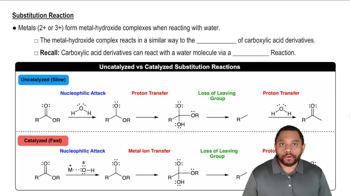
  • Nucleophilic Acyl Substitution

    Mechanism where a nucleophile replaces a leaving group on a carbonyl carbon, central to ester hydrolysis.
  • Ester

    Carboxylic acid derivative featuring an alkoxy group, commonly undergoing hydrolysis to form acids and alcohols.
  • Activated Water Molecule

    Water species modified by coordination with a metal ion, increasing its reactivity in catalytic processes.
  • Metal Hydroxide Complex

    Structure formed when a metal ion binds to hydroxide, often acting as a catalyst in hydrolysis reactions.
  • Catalysis

    Acceleration of a chemical reaction by a substance, such as a metal ion, that is not consumed in the process.
  • Proton Transfer

    Movement of a hydrogen ion between molecules or within a molecule, facilitating reaction steps like leaving group activation.
  • Carboxylate Anion

    Negatively charged species formed by deprotonation of a carboxylic acid, often the final product in hydrolysis.
  • Leaving Group

    Atom or group that departs with an electron pair during a substitution or elimination reaction, enabling bond formation.
  • Deprotonation

    Removal of a proton from a molecule, often resulting in the formation of an anion such as carboxylate.