Back

Making Ethers - Acid-Catalyzed Alkoxylation quiz

Control buttons has been changed to "navigation" mode.
1/15
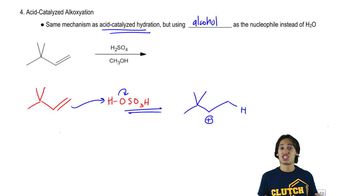
  • What is the nucleophile used in acid-catalyzed alkoxylation to synthesize ethers?

    An alcohol is used as the nucleophile instead of water.
  • What is the first step in the mechanism of acid-catalyzed alkoxylation of alkenes?

    The first step is the nucleophilic attack of the alkene on the proton (H) from the strong acid, forming a carbocation.
  • Why might a carbocation rearrangement occur during acid-catalyzed alkoxylation?

    A carbocation rearrangement occurs to move the positive charge to a more stable location, such as from a secondary to a tertiary carbon.
  • What type of shift is likely if only methyl groups are adjacent to the carbocation during the reaction?

    A methyl shift will occur if only methyl groups are adjacent to the carbocation.
  • After carbocation rearrangement, what attacks the carbocation in acid-catalyzed alkoxylation?

    The alcohol (as the nucleophile) attacks the carbocation.
  • What functional group is formed as the product of acid-catalyzed alkoxylation?

    An ether (R–O–R) is formed as the product.
  • What role does the conjugate base of the acid play in the final step of the mechanism?

    The conjugate base deprotonates the oxonium ion, regenerating the acid catalyst.
  • How is acid-catalyzed alkoxylation similar to acid-catalyzed hydration?

    Both involve electrophilic addition to an alkene, but alkoxylation uses alcohol instead of water as the nucleophile.
  • What is regenerated at the end of the acid-catalyzed alkoxylation reaction?

    The acid catalyst (e.g., sulfuric acid) is regenerated.
  • What is the purpose of protonating the double bond in the first step?

    Protonating the double bond creates a carbocation intermediate, making the molecule more reactive.
  • What is the general structure of the ether formed in this reaction?

    The general structure is R–O–R, where R represents alkyl groups.
  • Why is it important to consider carbocation stability in this mechanism?

    Carbocation stability determines whether a rearrangement (like a methyl shift) will occur to form a more stable intermediate.
  • What would be the nucleophile in acid-catalyzed hydration instead of alkoxylation?

    Water would be the nucleophile in acid-catalyzed hydration.
  • What happens if you draw an extra bond or stick in the product structure by mistake?

    You should either erase the extra stick or replace it with a hydrogen to accurately represent the molecule.
  • What key concepts are illustrated by the acid-catalyzed alkoxylation mechanism?

    The mechanism illustrates carbocation rearrangement, nucleophilicity, and acid-base catalysis.