Back

Making Ethers - Acid-Catalyzed Alkoxylation definitions

Control buttons has been changed to "navigation" mode.
1/15
  • Ether

    A compound featuring an oxygen atom bonded to two alkyl or aryl groups, formed via acid-catalyzed alkoxylation.
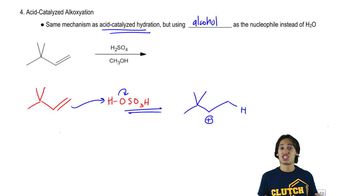
  • Acid-Catalyzed Alkoxylation

    A process where an alcohol acts as a nucleophile, adding to an alkene in the presence of acid to yield an ether.
  • Alkene

    A hydrocarbon containing a carbon-carbon double bond, serving as the starting material for electrophilic addition.
  • Nucleophile

    A species with electron density that seeks positively charged centers, such as alcohol attacking a carbocation.
  • Carbocation

    A positively charged carbon intermediate formed after protonation of a double bond, prone to rearrangement.
  • Methyl Shift

    A rearrangement where a methyl group migrates to stabilize a carbocation, often leading to a more substituted center.
  • Hydride Shift

    A rearrangement involving migration of a hydrogen atom with its electrons to stabilize a carbocation.
  • Sulfuric Acid

    A strong acid commonly used as a catalyst to protonate alkenes and facilitate ether formation.
  • Conjugate Base

    The species formed after an acid donates a proton, often responsible for deprotonating intermediates in the mechanism.
  • Deprotonation

    The removal of a proton from a molecule, typically regenerating the acid catalyst in the final step.
  • Electrophilic Addition

    A reaction where an electron-rich double bond reacts with an electrophile, initiating the formation of a carbocation.
  • Alcohol

    An organic molecule containing a hydroxyl group, serving as the nucleophile in acid-catalyzed alkoxylation.
  • Alkoxide Ion

    The conjugate base of an alcohol, featuring a negatively charged oxygen, involved in nucleophilic attack.
  • Acid Catalyst

    A substance that increases reaction rate by donating a proton and is regenerated at the end of the mechanism.
  • Carbocation Rearrangement

    A process where a carbocation changes position to achieve greater stability, often via methyl or hydride shifts.