Back

Leaving Group Conversions - Sulfonyl Chlorides quiz

Control buttons has been changed to "navigation" mode.
1/15
  • Why are alcohols considered poor leaving groups in organic reactions?

    Alcohols are poor leaving groups because they do not stabilize the negative charge well after departure, making them less reactive in substitution and elimination reactions.
  • What is the main advantage of converting an alcohol to a sulfonate ester?

    Sulfonate esters are excellent leaving groups due to their stability and ability to delocalize negative charge, making subsequent reactions more efficient.
  • What reagent is commonly used to convert an alcohol into a sulfonate ester?

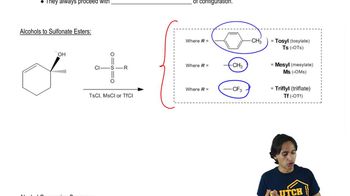
    A sulfonyl chloride, such as tosyl chloride, mesyl chloride, or triflyl chloride, is used to convert an alcohol into a sulfonate ester.
  • Describe the general structure of a sulfonate ester.

    A sulfonate ester has a sulfur atom double bonded to two oxygen atoms, single bonded to an R group, and single bonded to an oxygen atom connected to the original alcohol carbon.
  • How does the identity of the R group in a sulfonate ester affect its name?

    The R group determines the specific name: methyl gives mesylate, benzene with methyl gives tosylate, and trifluoromethyl gives triflate.
  • What is the difference between a sulfonate ester and a sulfonyl chloride?

    A sulfonate ester has an oxygen atom where a sulfonyl chloride has a chlorine atom attached to the sulfur.
  • During the conversion of an alcohol to a sulfonate ester, which atom acts as the nucleophile?

    The oxygen atom of the alcohol acts as the nucleophile, attacking the sulfur atom of the sulfonyl chloride.
  • Which atom in the sulfonyl chloride is most electrophilic and attacked by the alcohol?

    The sulfur atom in the sulfonyl chloride is the most electrophilic and is attacked by the alcohol's oxygen.
  • What happens to the chloride ion during the formation of a sulfonate ester?

    The chloride ion is expelled as a leaving group when the alcohol oxygen bonds to the sulfur atom.
  • What is the final charge state of the sulfonate ester after the reaction is complete?

    The final sulfonate ester is a neutral compound with no formal charges.
  • Can sulfonate esters be stored for later use in reactions?

    Yes, sulfonate esters are stable and can be stored for later use in nucleophilic substitution reactions.
  • What type of stereochemical outcome does the conversion of alcohol to sulfonate ester have?

    The conversion proceeds with retention of configuration, meaning the spatial arrangement around the reactive center remains unchanged.
  • How does the mechanism of sulfonate ester formation differ from that of thionyl chloride or phosphorus tribromide reactions?

    Sulfonate ester formation proceeds with retention of configuration, while thionyl chloride and phosphorus tribromide reactions proceed with inversion of configuration.
  • What is the role of the base (such as the expelled chloride ion) in the final step of sulfonate ester formation?

    The base removes the proton from the oxygen, resulting in a neutral sulfonate ester.
  • After forming a sulfonate ester, what type of reaction can it undergo with a nucleophile?

    The sulfonate ester can undergo nucleophilic substitution, typically via a backside attack by the nucleophile.