Back

Leaving Group Conversions - Sulfonyl Chlorides definitions

Control buttons has been changed to "navigation" mode.
1/14
  • Sulfonate Ester

    A compound with a sulfur atom double bonded to two oxygens, bonded to an R group and an oxygen, known for exceptional leaving group ability.
  • Sulfonyl Chloride

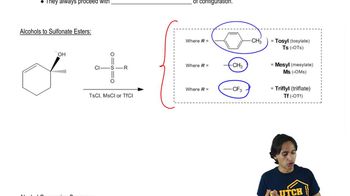
    A reagent with a sulfur atom double bonded to two oxygens, bonded to a chlorine and an R group, used to convert alcohols into sulfonate esters.
  • Leaving Group

    An atom or group that departs with a pair of electrons during a reaction, with stability enhanced by charge delocalization.
  • Tosylate

    A sulfonate ester where the R group is a benzene ring with a methyl group, valued for its stability as a leaving group.
  • Mesylate

    A sulfonate ester with a methyl group as the R group, offering excellent leaving group properties in substitution reactions.
  • Triflate

    A sulfonate ester with a trifluoromethyl group as the R group, recognized for its outstanding leaving group ability.
  • Nucleophile

    A species with electron-rich atoms, such as oxygen in alcohols, that attacks electrophilic centers like sulfur in sulfonyl chlorides.
  • Electrophile

    An atom or group, often with a partial positive charge, that attracts nucleophiles; sulfur in sulfonyl chlorides is a prime example.
  • Retention of Configuration

    A process where the spatial arrangement around a reactive center remains unchanged during a chemical transformation.
  • Alkyl Halide

    A compound where a halogen is bonded to an alkyl group, often compared to sulfonate esters for their reactivity and storage.
  • R Group

    A variable organic substituent that determines the specific identity of a sulfonate ester, such as methyl, benzyl, or trifluoromethyl.
  • Delocalization

    The distribution of negative charge over multiple atoms, enhancing the stability of leaving groups like sulfonate esters.
  • Stereochemistry

    The study of spatial arrangements of atoms, crucial for understanding configuration changes during chemical reactions.
  • Backside Attack

    A mechanism in which a nucleophile approaches from the side opposite the leaving group, leading to inversion of configuration.