Back

Leaving Group Conversions - SOCl2 and PBr3 quiz

Control buttons has been changed to "navigation" mode.
1/15
  • Why are alcohols considered poor leaving groups in organic reactions?

    Alcohols are poor leaving groups because the hydroxide ion (OH-) is a strong base and unstable as a free ion, making it unlikely to leave on its own.
  • What are the two common reagents used to convert alcohols into alkyl halides?

    The two common reagents are thionyl chloride (SOCl2) and phosphorus tribromide (PBr3).
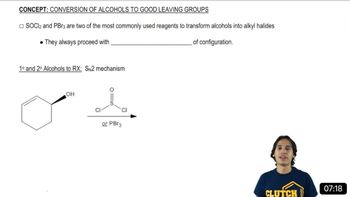
  • What type of mechanism do SOCl2 and PBr3 use to convert alcohols to alkyl halides?

    They use an SN2 mechanism, which involves a backside attack by the nucleophile.
  • Why are SOCl2 and PBr3 reactions limited to primary and secondary alcohols?

    These reactions are limited to primary and secondary alcohols because tertiary alcohols are too sterically hindered for the SN2 backside attack to occur.
  • What stereochemical outcome results from the SN2 mechanism with SOCl2 or PBr3?

    The product will have inversion of configuration at the carbon where substitution occurs.
  • What is the structure of thionyl chloride (SOCl2)?

    Thionyl chloride consists of a sulfur atom double-bonded to an oxygen and single-bonded to two chlorine atoms.
  • During the reaction with SOCl2, which atom does the alcohol's oxygen attack and why?

    The alcohol's oxygen attacks the sulfur atom because it has the largest partial positive charge due to the electron-withdrawing effects of the surrounding atoms.
  • What happens to the double bond between sulfur and oxygen when the alcohol attacks SOCl2?

    The double bond electrons are pushed up onto the oxygen, creating an O- group.
  • After the initial attack on SOCl2, what is the next key step in the mechanism?

    The negative charge on the oxygen reforms the double bond to sulfur, kicking out a chloride ion as a leaving group.
  • Why is the leaving group formed in the SOCl2 mechanism considered excellent?

    It is excellent because it becomes neutral after leaving and is stabilized by the electron-withdrawing sulfur atom.
  • What role does the chloride ion play after being expelled in the SOCl2 mechanism?

    The chloride ion acts as a nucleophile, attacking the carbon and displacing the leaving group via backside attack.
  • How does the stereochemistry of the product relate to the original alcohol in the SOCl2 reaction?

    The product's stereochemistry is inverted compared to the original alcohol due to the SN2 mechanism.
  • What is the main organic product when a primary alcohol reacts with SOCl2?

    The main product is a primary alkyl chloride with inverted configuration at the reacting carbon.
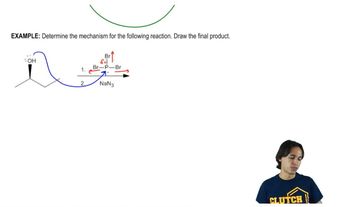
  • How does the mechanism of PBr3 compare to that of SOCl2?

    The mechanism of PBr3 is essentially the same as SOCl2, involving SN2 substitution and inversion of configuration.
  • Why do organic chemistry professors emphasize knowing the stereochemistry of the product in these reactions?

    Because understanding the stereochemistry demonstrates a clear grasp of the SN2 mechanism and its consequences on molecular structure.