Back

Leaving Group Conversions - SOCl2 and PBr3 definitions

Control buttons has been changed to "navigation" mode.
1/15
  • Alcohol

    A compound with a hydroxyl group attached to a saturated carbon, often converted to alkyl halides due to poor leaving group ability.
  • Alkyl Halide

    A molecule formed when a halogen replaces a hydroxyl group, commonly produced from alcohols using SOCl2 or PBr3.
  • SOCl2

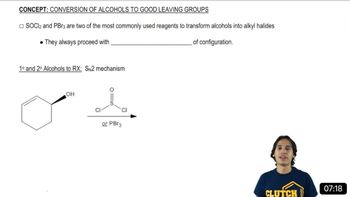
    A reagent with a highly electrophilic sulfur, used to convert alcohols to alkyl chlorides via nucleophilic substitution.
  • PBr3

    A reagent that transforms alcohols into alkyl bromides through a mechanism similar to SOCl2, favoring primary and secondary alcohols.
  • SN2 Mechanism

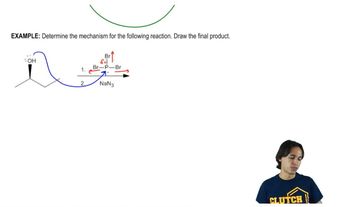
    A one-step nucleophilic substitution involving backside attack, leading to inversion of configuration at the reactive center.
  • Backside Attack

    A process where a nucleophile approaches the substrate from the side opposite the leaving group, causing stereochemical inversion.
  • Inversion of Configuration

    A stereochemical outcome where the spatial arrangement at a chiral center is flipped due to backside attack in SN2 reactions.
  • Leaving Group

    An atom or group that departs with a pair of electrons during substitution, with effectiveness enhanced by SOCl2 or PBr3.
  • Thionyl Chloride

    A molecule with sulfur, oxygen, and two chlorines, notable for its strong electrophilic character in alcohol conversions.
  • Nucleophile

    A species rich in electrons, such as the oxygen in alcohols, that attacks electrophilic centers like sulfur in SOCl2.
  • Electrophile

    An atom or group with a partial positive charge, attracting nucleophiles; sulfur in SOCl2 is a prime example.
  • Primary Alcohol

    A substrate with the hydroxyl group attached to a carbon bonded to only one other carbon, ideal for SN2 reactions.
  • Secondary Alcohol

    A substrate where the hydroxyl group is on a carbon connected to two other carbons, suitable for SN2-based halide formation.
  • Tertiary Alcohol

    A substrate with the hydroxyl group on a carbon bonded to three other carbons, generally unreactive in SN2 with SOCl2 or PBr3.
  • Stereochemistry

    The three-dimensional arrangement of atoms in molecules, crucial for understanding outcomes like inversion during SN2 reactions.