Back

Ionization of Aromatics quiz

Control buttons has been changed to "navigation" mode.
1/15
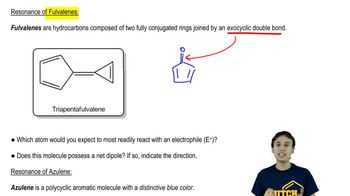
  • What is an exocyclic double bond in the context of aromatic molecules?

    An exocyclic double bond is a double bond located outside of a ring system, not part of the ring itself. It can be used as a loose pair of electrons for resonance and ionization to enhance aromatic stability.
  • How does ionizing the exocyclic double bond in fovalene contribute to aromatic stability?

    Ionizing the exocyclic double bond creates a negative charge on a six-membered ring and a positive charge on another ring, resulting in 6 pi electrons in one ring and 2 pi electrons in the other, both numbers favored by Huckel's rule.
  • Which atom in fovalene is most likely to react with an electrophile (E+)?

    The atom bearing the negative charge after ionization is most likely to react with an electrophile, as it is the most nucleophilic site in the molecule.
  • Does fovalene possess a net dipole, and if so, in which direction?

    Yes, fovalene possesses a net dipole, which points toward the atom with the negative charge after ionization.
  • Why is the resonance structure with 6 pi electrons in one ring and 2 pi electrons in the other more stable for fovalene?

    This arrangement follows Huckel's rule, which predicts unusual stability for rings with 2 or 6 pi electrons, making the molecule aromatic and stable.
  • What happens if you ionize fovalene to give 4 pi electrons in each ring?

    This results in two anti-aromatic rings, which are highly unstable and unfavorable compared to the aromatic arrangement.
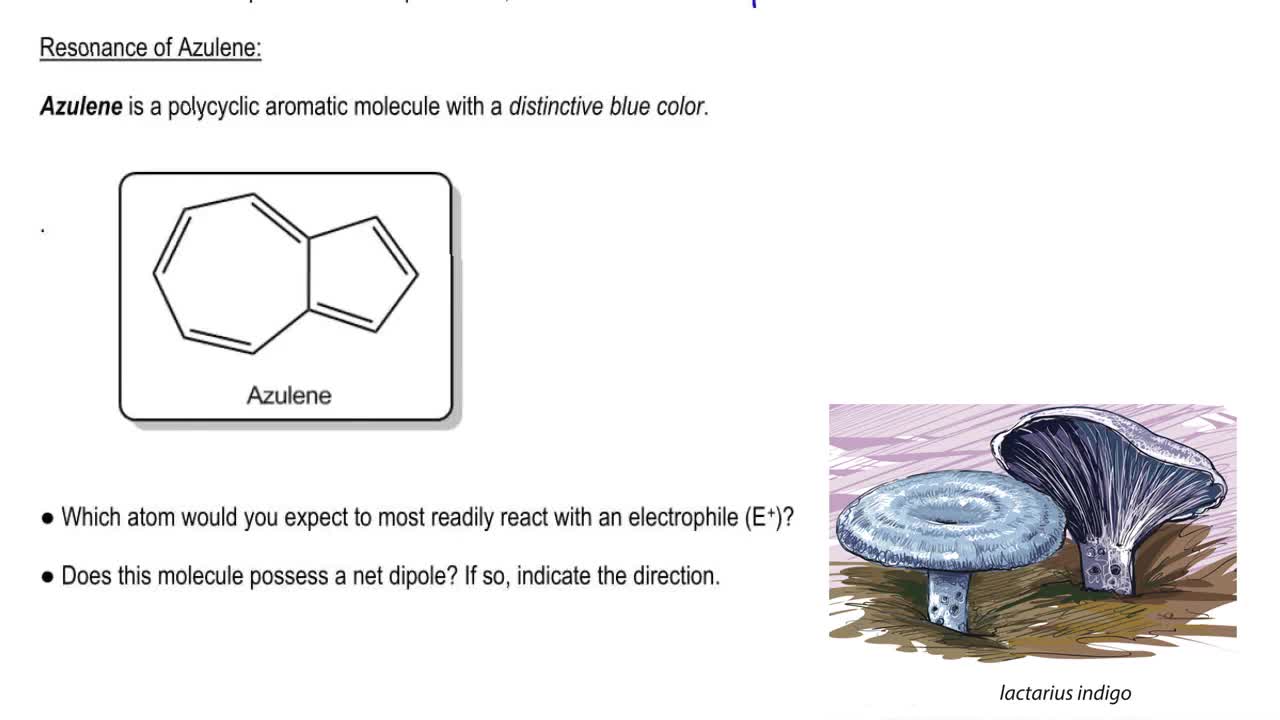
  • What is the main goal when drawing resonance structures for polycyclic aromatic molecules like azulene?

    The goal is to share a double bond between both rings so that each ring can achieve aromaticity, typically with 6 pi electrons each.
  • Does azulene have an exocyclic double bond?

    No, azulene does not have an exocyclic double bond; its resonance involves sharing a double bond between rings.
  • How many pi electrons are present in each ring of the most stable resonance structure of azulene?

    Each ring in the most stable resonance structure of azulene has 6 pi electrons, making both rings aromatic.
  • Which atom in azulene is most likely to react with an electrophile?

    The atom with the full negative charge in the resonance structure is most likely to react with an electrophile due to its nucleophilicity.
  • Does azulene possess a net dipole, and what is its significance?

    Yes, azulene possesses a strong net dipole, which contributes to its distinctive blue color and unique physical properties.
  • What is the effect of having 8 pi electrons in one ring and 4 pi electrons in the other for azulene?

    This arrangement is highly unstable and non-aromatic, making it an unfavorable resonance structure for azulene.
  • How does aromaticity influence the ionization behavior of molecules like fovalene and azulene?

    Aromaticity drives these molecules to ionize and form strong dipoles, as this helps them achieve greater stability by following Huckel's rule.
  • What is Huckel's rule and how does it relate to aromatic stability?

    Huckel's rule states that rings with 2, 6, 10, etc., pi electrons are aromatic and unusually stable, guiding resonance and ionization in aromatic molecules.
  • Why is resonance important in achieving aromatic stability in organic molecules?

    Resonance allows for the distribution of charges and electrons in a way that maximizes aromaticity, leading to greater molecular stability.