Back

Ionization of Aromatics definitions

Control buttons has been changed to "navigation" mode.
1/15
  • Aromaticity

    A property granting unusual stability to cyclic molecules with a specific number of pi electrons, as predicted by Huckel's rule.
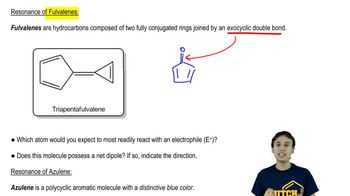
  • Fovalene

    A hydrocarbon with two conjugated rings and an exocyclic double bond, capable of ionizing to enhance aromatic stability.
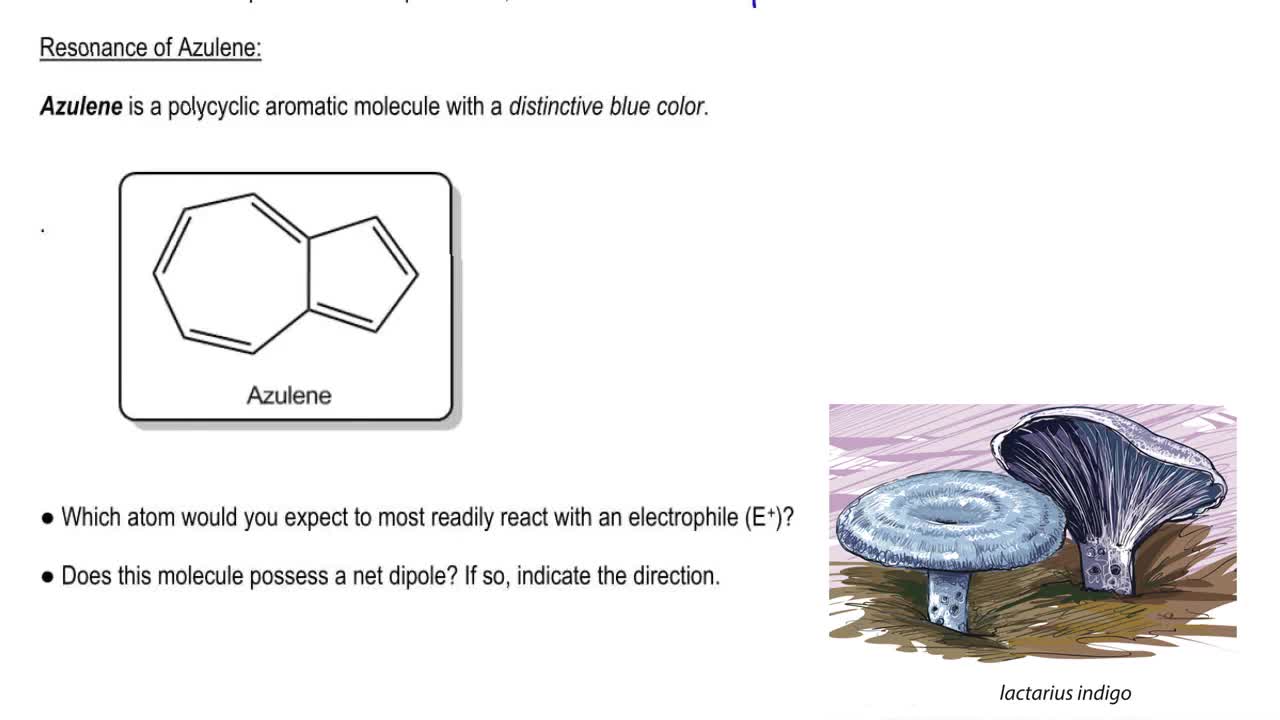
  • Azulene

    A polycyclic aromatic molecule with a strong dipole and vivid blue color, stabilized by resonance sharing between rings.
  • Exocyclic Double Bond

    A double bond located outside a ring system, often serving as a source of electrons for resonance and ionization.
  • Resonance Structure

    A depiction of electron distribution in a molecule, showing alternative placements of charges and bonds to maximize stability.
  • Dipole

    A separation of charge within a molecule, resulting in a directional polarity that influences physical and chemical properties.
  • Huckel's Rule

    A guideline stating that cyclic, planar molecules with 4n+2 pi electrons exhibit aromatic stability.
  • Pi Electrons

    Electrons found in p orbitals that participate in delocalized bonding, crucial for aromatic stabilization.
  • Conjugated Ring

    A cyclic structure with alternating single and double bonds, allowing for delocalization of pi electrons.
  • Ionization

    The process where a molecule forms charged species, often to achieve greater aromatic stability.
  • Electrophile

    A species attracted to electron-rich sites, often reacting with negatively charged atoms in aromatic systems.
  • Nucleophilicity

    A measure of an atom's tendency to donate electrons, often enhanced by negative charge in resonance structures.
  • Polycyclic Aromatic Molecule

    A compound containing multiple fused aromatic rings, often requiring resonance sharing for stability.
  • Aromatic Stability

    The enhanced resistance to reaction and increased stability observed in molecules with aromatic character.
  • Negative Charge

    An excess of electrons localized on an atom, often increasing nucleophilicity and influencing resonance.