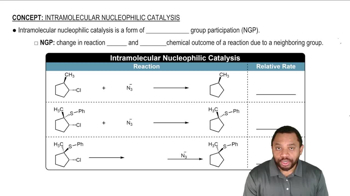
What is intramolecular nucleophilic catalysis also known as?
It is also known as neighboring group participation (NGP).
How does neighboring group participation (NGP) affect a reaction?
NGP changes the reaction rate and the stereochemical outcome due to the influence of a neighboring group.
What type of reaction does the azide ion perform on a cyclopentane ring with chlorine?
The azide ion performs an SN2 reaction, leading to inversion of configuration.
What happens to the bond configuration after an SN2 reaction with azide ion?
The bond inverts, so the azide ion ends up on a wedge bond.
How does the presence of a sulfur with a phenyl ring affect the reaction rate?
It creates steric hindrance, making it harder for the chlorine group to leave and slowing the reaction rate.
What is the effect of intramolecular processes on reaction speed compared to intermolecular ones?
Intramolecular processes are generally faster due to reduced steric hindrance.
What intermediate is formed when sulfur's lone pairs attack the carbon in the cyclopentane ring?
A three-membered ring intermediate is formed, with sulfur making three bonds and becoming positively charged.
Why is there angle strain in the three-membered ring intermediate?
Angle strain arises because three-membered rings have bond angles much less than the ideal tetrahedral angle.
Which carbon does the nucleophile attack when opening the three-membered ring?
The nucleophile attacks the less substituted carbon, similar to epoxide ring openings.
What happens to the bond configuration after the ring is opened by the nucleophile?
The bond inverts back to the azide ion after the ring is opened.
How does the methyl group affect the azide ion's approach in intermolecular reactions?
The methyl group causes some steric hindrance, making the reaction moderately fast.
Which scenario is the slowest: intramolecular, methyl group, or sulfur-phenyl group?
The sulfur-phenyl group scenario is the slowest due to significant steric hindrance.
How does the neighboring group affect the stereochemistry of the reaction?
The neighboring group can cause inversion of configuration during the reaction.
What role does the sulfur with a phenyl group play in the intramolecular process?
It helps enhance the leaving of the chlorine group by forming a strained ring intermediate.
Why are intramolecular reactions generally faster than intermolecular reactions?
Intramolecular reactions are faster because the nucleophile and electrophile are within the same molecule, reducing steric hindrance and increasing effective concentration.