Back

Intramolecular Nucleophilic Catalysis definitions

Control buttons has been changed to "navigation" mode.
1/15
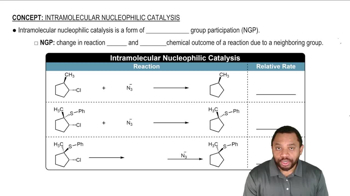
  • Intramolecular Nucleophilic Catalysis

    A process where a group within a molecule accelerates reaction by assisting nucleophile attack, often increasing reaction speed.
  • Neighboring Group Participation

    A phenomenon where an adjacent group influences reaction rate and stereochemistry by interacting with the reaction center.
  • Azide Ion

    A negatively charged nucleophile that attacks electrophilic carbons, often causing inversion of configuration in SN2 reactions.
  • Cyclopentane Ring

    A five-membered carbon ring structure that can host various substituents, affecting reaction pathways and rates.
  • SN2 Reaction

    A substitution mechanism where a nucleophile attacks from the opposite side, causing inversion of configuration.
  • Inversion of Configuration

    A stereochemical outcome where the spatial arrangement of groups around a carbon flips during nucleophilic substitution.
  • Steric Hindrance

    A slowdown in reaction rate caused by bulky groups blocking access to the reactive site.
  • Angle Strain

    A destabilizing effect in small rings, like three-membered rings, due to bond angles deviating from ideal values.
  • Leaving Group

    An atom or group that departs with a pair of electrons during a substitution or elimination reaction.
  • Benzene Ring

    A planar, six-carbon aromatic ring that, when attached to other atoms, can increase steric bulk and affect reactivity.
  • Three-Membered Ring

    A strained cyclic intermediate formed during some intramolecular reactions, prone to nucleophilic attack.
  • Methyl Group

    A small alkyl substituent that can influence reaction rates by contributing to steric effects.
  • Phenyl Group

    An aromatic substituent derived from benzene, often increasing steric hindrance when attached to a molecule.
  • Relative Rate

    A comparison of how quickly different reaction pathways proceed under similar conditions.
  • Epoxide Ring Opening

    A process where a nucleophile attacks a strained three-membered ring, typically at the less substituted carbon.