Organic Chemistry
My Course
Learn
Exam Prep
AI Tutor
Study Guides
Textbook Solutions
Flashcards
Explore
Try the app
My Course
Learn
Exam Prep
AI Tutor
Study Guides
Textbook Solutions
Flashcards
Explore
Try the app
Back
Intramolecular Aldol Condensation quiz
You can tap to flip the card.
What type of rings are favored in intramolecular aldol condensations of dicarbonyl compounds?
You can tap to flip the card.
👆
What type of rings are favored in intramolecular aldol condensations of dicarbonyl compounds?
Five- and six-membered rings are favored because smaller rings are too unstable to form easily.
Track progress
Control buttons has been changed to "navigation" mode.
1/15
Related flashcards
Related practice
Recommended videos
Intramolecular Aldol Condensation definitions
Intramolecular Aldol Condensation
15 Terms
Intramolecular Aldol Condensation
25. Condensation Chemistry
4 problems
Topic

Laura
Conjugate Addition
25. Condensation Chemistry
7 problems
Topic

Johnny
22. Condensation Chemistry - Part 1 of 2
3 topics
9 problems
Chapter
Ernest
22. Condensation Chemistry - Part 2 of 2
3 topics
9 problems
Chapter
Johnny
Guided course
03:27
Diesters (Dieckmann Condensation)
4
views
Guided course
05:52
Diketones
4
views
Terms in this set (15)
Hide definitions
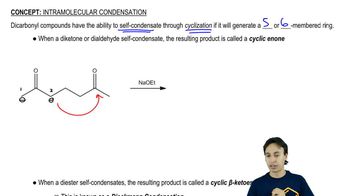
What type of rings are favored in intramolecular aldol condensations of dicarbonyl compounds?
Five- and six-membered rings are favored because smaller rings are too unstable to form easily.
Why are three- and four-membered rings rarely formed in intramolecular condensations?
They are too unstable and require significant energy input to form.
What is the key intermediate formed during an intramolecular aldol condensation?
An enolate ion is formed, which then attacks another carbonyl group within the same molecule.
How do you determine where to form the enolate in a diketone for cyclization?
You choose the position that will allow the enolate to attack a carbonyl and form a five- or six-membered ring.
What is the product of an intramolecular aldol condensation before dehydration?
A beta hydroxycarbonyl compound is formed.
What happens to the beta hydroxycarbonyl product under dehydration conditions?
It loses water to form a cyclic enone, which is a stable product.
What is the final product called when a diketone undergoes intramolecular aldol condensation and dehydration?
The final product is a cyclic enone.
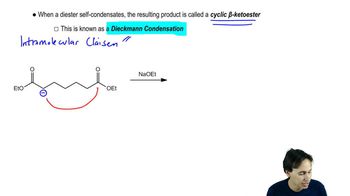
What type of compounds undergo intramolecular Claisen condensation?
Diesters undergo intramolecular Claisen condensation.
What is the product of an intramolecular Claisen condensation (also called Dieckmann condensation)?
The product is a cyclic beta ketoester.
How do you confirm that the product of a Dieckmann condensation is correct?
Check that the product is cyclic and contains both a ketone and an ester group at the beta position.
What determines whether a five- or six-membered ring will form in an intramolecular condensation?
The position of enolate formation and the distance to the electrophilic carbonyl determine the ring size.
What is the main difference between an intramolecular aldol and an intramolecular Claisen condensation?
Aldol involves ketones or aldehydes, while Claisen involves esters.
What is the role of the base (like NaOEt) in these intramolecular condensations?
The base deprotonates an alpha hydrogen to form the enolate ion.
Why is numbering the ring important when drawing the product of an intramolecular condensation?
Numbering helps ensure all groups are correctly placed and the ring structure is accurate.
What is another name for the intramolecular Claisen condensation?
It is also called the Dieckmann condensation.