Organic Chemistry
My Course
Learn
Exam Prep
AI Tutor
Study Guides
Textbook Solutions
Flashcards
Explore
Try the app
My Course
Learn
Exam Prep
AI Tutor
Study Guides
Textbook Solutions
Flashcards
Explore
Try the app
Back
Intramolecular Aldol Condensation definitions
You can tap to flip the card.
Intramolecular Condensation
You can tap to flip the card.
👆
Intramolecular Condensation
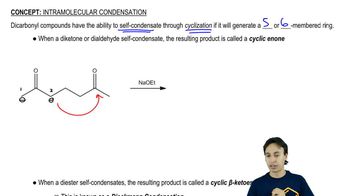
A process where a single molecule forms a ring by self-condensation, typically yielding 5 or 6 membered rings for stability.
Track progress
Control buttons has been changed to "navigation" mode.
1/15
Related flashcards
Related practice
Recommended videos
Intramolecular Aldol Condensation quiz
Intramolecular Aldol Condensation
15 Terms
Intramolecular Aldol Condensation
25. Condensation Chemistry
4 problems
Topic

Laura
Conjugate Addition
25. Condensation Chemistry
7 problems
Topic

Johnny
22. Condensation Chemistry - Part 1 of 2
3 topics
9 problems
Chapter
Ernest
22. Condensation Chemistry - Part 2 of 2
3 topics
9 problems
Chapter
Johnny
Guided course
03:27
Diesters (Dieckmann Condensation)
4
views
Guided course
05:52
Diketones
4
views
Terms in this set (15)
Hide definitions
Intramolecular Condensation
A process where a single molecule forms a ring by self-condensation, typically yielding 5 or 6 membered rings for stability.
Dicarbonyl Compound
A molecule containing two carbonyl groups, often serving as the starting material for ring-forming condensations.
Cyclization
The transformation of a linear molecule into a ring structure, favored when forming 5 or 6 membered rings.
Enolate
A resonance-stabilized anion formed by deprotonation at the alpha position of a carbonyl, acting as a nucleophile in condensation.
Beta Hydroxycarbonyl
A compound featuring a hydroxyl group on the beta carbon relative to a carbonyl, often an intermediate in aldol reactions.
Cyclic Enone
A ring structure containing a conjugated ketone and alkene, typically formed by dehydration of a beta hydroxycarbonyl.
Diester
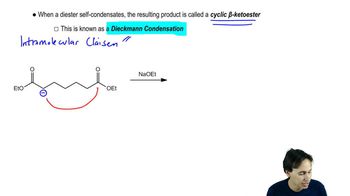
A molecule with two ester groups, capable of undergoing intramolecular condensation to form cyclic products.
Claisen Reaction
A condensation between esters or one ester and a ketone, producing a beta ketoester, especially in ring-forming variants.
Cyclic Beta Ketoester
A ring system containing both a ketone and an ester group at the beta position, the hallmark product of intramolecular Claisen condensation.
Ring Size
A critical factor in cyclization reactions, with 5 or 6 membered rings being most stable and commonly formed.
Alpha Hydrogen
A hydrogen atom attached to the carbon adjacent to a carbonyl, whose removal enables enolate formation.
Nucleophile
An electron-rich species, such as an enolate, that attacks an electrophilic carbonyl during condensation.
Electrophile
An electron-deficient atom, typically a carbonyl carbon, targeted by nucleophiles in condensation mechanisms.
Dehydration
A step where water is eliminated from a beta hydroxycarbonyl, leading to the formation of a conjugated enone.
Dyckman Condensation
An alternative name for the intramolecular Claisen condensation, yielding cyclic beta ketoesters from diesters.