Back

Intramolecular Acid-Base Catalysis quiz

Control buttons has been changed to "navigation" mode.
1/15
  • What is an intramolecular catalyst in the context of acid-base catalysis?

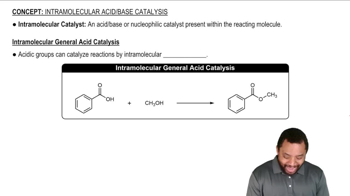
    It is an acid, base, or nucleophilic catalyst present within the reacting molecule itself.
  • How does an acidic group within a molecule catalyze a reaction?

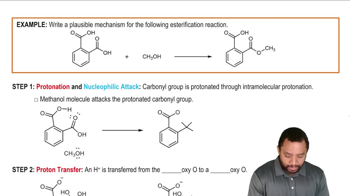
    It can catalyze reactions by intramolecular protonation, enhancing the reaction rate.
  • Which functional group is commonly used as an acidic group in intramolecular acid catalysis?

    A carboxylic acid group is commonly used as the acidic group.
  • What is the role of a carboxylic acid in ester formation via intramolecular catalysis?

    The carboxylic acid acts as an acidic group that helps catalyze the formation of the ester.
  • What does intramolecular general base catalysis involve?

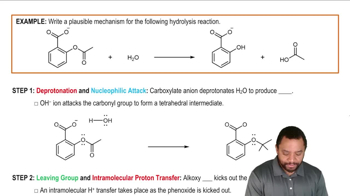
    It involves a basic group within the molecule catalyzing hydrolysis by deprotonating water.
  • What ion is generated when a basic group deprotonates water during base catalysis?

    Hydroxide ions (OH-) are generated.
  • How does the presence of a basic group on the same molecule as an ester affect hydrolysis?

    It results in the fastest hydrolysis rate compared to other scenarios.
  • What are the products of ester hydrolysis?

    The products are an alcohol and a carboxylic acid.
  • How does adding a weak base to water affect the rate of ester hydrolysis?

    It increases the rate by generating some hydroxide ions, making the reaction faster than with water alone.
  • Rank the hydrolysis rates of an ester with water alone, with added weak base, and with an intramolecular basic group.

    Water alone is slowest, water with weak base is moderate, and with an intramolecular basic group is fastest.
  • Why is intramolecular catalysis generally faster than intermolecular catalysis?

    Because the catalytic group is already positioned within the molecule, facilitating the reaction more efficiently.
  • What is the main advantage of intramolecular acid-base catalysis in chemical reactions?

    It significantly enhances reaction rates due to proximity and effective positioning of catalytic groups.
  • What happens to the ester bond during base-catalyzed hydrolysis?

    The ester bond splits, forming an alcohol and a carboxylic acid.
  • In the context of catalysis, what does 'intramolecular' mean?

    It means the catalytic group is part of the same molecule as the reacting functional group.
  • What is the effect of intramolecular interactions on chemical reaction rates?

    Intramolecular interactions can greatly increase reaction rates by facilitating more efficient catalysis.