Organic Chemistry
My Course
Learn
Exam Prep
AI Tutor
Study Guides
Textbook Solutions
Flashcards
Explore
Try the app
My Course
Learn
Exam Prep
AI Tutor
Study Guides
Textbook Solutions
Flashcards
Explore
Try the app
Back
Intramolecular Acid-Base Catalysis definitions
You can tap to flip the card.
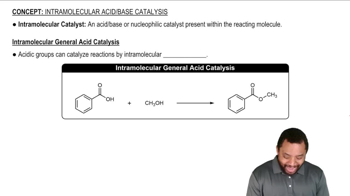
Intramolecular Catalysis
You can tap to flip the card.
👆
Intramolecular Catalysis
Acceleration of a reaction by an acidic or basic group located within the same molecule as the reacting site.
Track progress
Control buttons has been changed to "navigation" mode.
1/14
Related flashcards
Recommended videos
Intramolecular Acid-Base Catalysis quiz
Intramolecular Acid-Base Catalysis
15 Terms
2:52
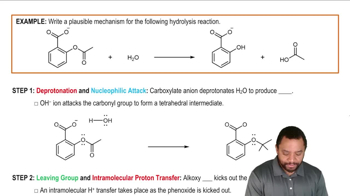
Intramolecular Acid-Base Catalysis Example 2
1
views
3:18
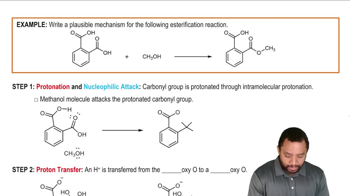
Intramolecular Acid-Base Catalysis Example 1
1
views
00:56
Intramolecular Acid-Base Catalysis Concept 1
1
views
Terms in this set (14)
Hide definitions
Intramolecular Catalysis
Acceleration of a reaction by an acidic or basic group located within the same molecule as the reacting site.
Acidic Group
Functional unit capable of donating a proton, often enhancing reaction rates through proton transfer within a molecule.
Basic Group
Functional unit capable of accepting a proton, often increasing reaction rates by deprotonating nearby groups.
Carboxylic Acid
Organic group containing a -COOH moiety, frequently acting as an internal acid catalyst in esterification.
Ester
Compound formed from an acid and an alcohol, often a product or substrate in acid-base catalyzed reactions.
Protonation
Addition of a hydrogen ion to a molecule, often facilitated by an internal acidic group to speed up reactions.
Deprotonation
Removal of a hydrogen ion from a molecule, commonly aided by an internal basic group to generate reactive species.
Hydrolysis
Cleavage of a chemical bond by water, with rates significantly increased by internal acid or base groups.
Hydroxide Ion
Negatively charged ion (OH−) generated by deprotonation of water, crucial for base-catalyzed hydrolysis.
Nucleophilic Catalyst
Internal group that donates electron pairs, enhancing reaction rates by stabilizing transition states.
Relative Rate
Comparison of reaction speeds under different catalytic conditions, highlighting the effect of internal groups.
Transition State
High-energy configuration during a reaction, whose stabilization by internal groups accelerates the process.
Alcohol
Product of ester hydrolysis, formed more rapidly when catalyzed by an internal base.
Ester Bond
Linkage between an acid and an alcohol, targeted for cleavage in hydrolysis reactions.