Back

Hydrohalogenation quiz

Control buttons has been changed to "navigation" mode.
1/15
  • What is the named reaction discussed in this section?

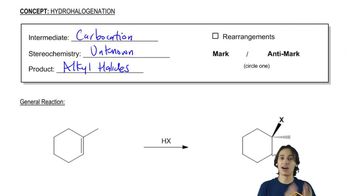
    The reaction is hydrohalogenation, which involves adding a hydrogen and a halogen as sigma bonds to a molecule.
  • What intermediate is formed during hydrohalogenation?

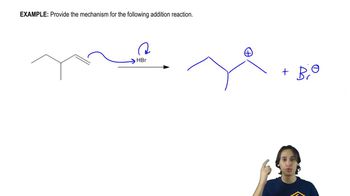
    A carbocation intermediate is formed during hydrohalogenation.
  • Why is the stereochemistry of the hydrohalogenation product unknown?

    Because the carbocation intermediate is trigonal planar, attack can occur from either side, resulting in unknown stereochemistry.
  • What type of product is formed from hydrohalogenation of a double bond?

    The product is an alkyl halide formed from the addition of HX to a double bond.
  • Are carbocation rearrangements expected in hydrohalogenation?

    Yes, carbocation rearrangements are expected whenever a carbocation intermediate is present.
  • What does regiochemistry determine in hydrohalogenation?

    Regiochemistry determines where the electrophile (halogen) adds to the molecule.
  • What rule governs the regiochemistry of hydrohalogenation?

    Markovnikov's rule governs the regiochemistry, favoring addition to the most substituted carbon.
  • In hydrohalogenation, where does the halogen attach on an asymmetrical alkene?

    The halogen attaches to the more substituted side of the double bond.
  • Where does the hydrogen attach during hydrohalogenation?

    The hydrogen attaches to the less substituted side of the double bond.
  • What does the squiggly line represent in hydrohalogenation products?

    The squiggly line represents unknown stereochemistry at the site of addition.
  • Why might the end product of hydrohalogenation not have a chiral center?

    If the addition does not create a chiral center, the product's stereochemistry is irrelevant.
  • What is the general reaction equation for hydrohalogenation?

    A double bond reacts with HX (hydrogen halide) to form an alkyl halide.
  • What is the shape of the carbocation intermediate in hydrohalogenation?

    The carbocation intermediate is trigonal planar.
  • What determines the stability of the carbocation formed in hydrohalogenation?

    The stability is determined by the degree of substitution; more substituted carbocations are more stable.
  • What happens if the attacking nucleophile approaches the carbocation from different sides?

    Attack from either side leads to a mixture of stereochemical products due to the planar nature of the carbocation.