Back

Hydrohalogenation definitions

Control buttons has been changed to "navigation" mode.
1/14
  • Hydrohalogenation

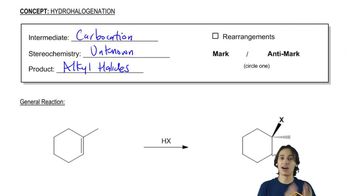
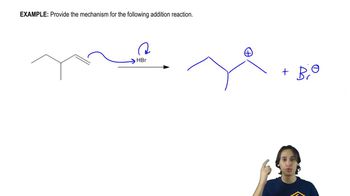
    A reaction where a hydrogen and a halogen are added across a double bond, forming alkyl halides.
  • Carbocation

    A planar, positively charged intermediate formed during the reaction, susceptible to rearrangement.
  • Sigma Bond

    A single covalent bond formed when atomic orbitals overlap directly between two atoms.
  • Alkyl Halide

    A compound produced when a halogen attaches to an alkyl group, typically as the product of this reaction.
  • Regiochemistry

    The aspect of a reaction that determines which atom or position a group adds to in a molecule.
  • Stereochemistry

    The study of the spatial arrangement of atoms in molecules and its effect on chemical behavior.
  • Markovnikov's Rule

    A guideline stating that the electrophile adds to the carbon with more hydrogens in an unsymmetrical alkene.
  • Hydrogen Halide

    A diatomic molecule composed of hydrogen and a halogen, such as HCl or HBr, used as a reactant.
  • Double Bond

    A chemical bond where two pairs of electrons are shared between two atoms, serving as the reactive site.
  • Carbocation Rearrangement

    A process where a carbocation shifts to a more stable position during a reaction mechanism.
  • Electrophile

    A species that seeks electrons and adds to the site of highest electron density in a molecule.
  • Trigonal Planar

    A molecular geometry where three atoms are arranged around a central atom in a flat, triangular shape.
  • Squiggly Line

    A notation indicating unknown or undefined stereochemistry at a specific position in a molecule.
  • Reactive Site

    The specific location within a molecule where a chemical reaction is most likely to occur.