Skip to main content
Organic Chemistry
My Course
Learn
Exam Prep
AI Tutor
Study Guides
Textbook Solutions
Flashcards
Explore
Try the app
My Course
Learn
Exam Prep
AI Tutor
Study Guides
Textbook Solutions
Flashcards
Explore
Try the app
Back
Free Radical Polymerization quiz
You can tap to flip the card.
What is radical polymerization?
You can tap to flip the card.
👆
What is radical polymerization?
Radical polymerization is a chain reaction involving radicals and alkenes that produces long hydrocarbon chains, forming polymers.
Track progress
Control buttons has been changed to "navigation" mode.
1/15
Related flashcards
Related practice
Recommended videos
Free Radical Polymerization definitions
Radical Polymerization
15 Terms
Free Radical Polymerization
11. Radical Reactions
1 problem
Topic
Johnny
Allylic Bromination
11. Radical Reactions
8 problems
Topic
Johnny
11. Radical Reactions - Part 1 of 2
4 topics
11 problems
Chapter
Johnny
11. Radical Reactions - Part 2 of 2
5 topics
13 problems
Chapter
Johnny
02:44
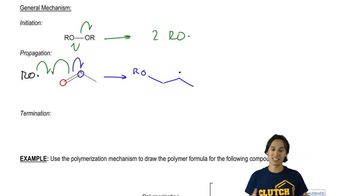
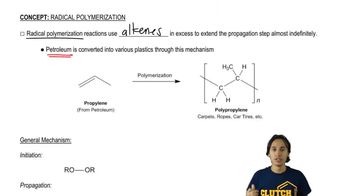
General features of Radical Polymerization.
7
views
03:28
The mechanism of Radical Polymerization.
7
views
02:20
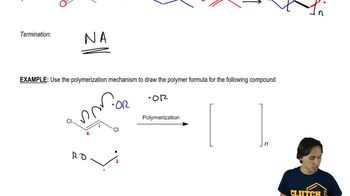
Use the polymerization mechanism to draw the polymer formula for the following compound.
9
views
Terms in this set (15)
Hide definitions
What is radical polymerization?
Radical polymerization is a chain reaction involving radicals and alkenes that produces long hydrocarbon chains, forming polymers.
What type of compounds are commonly used as radical initiators in polymerization?
Peroxides are commonly used as radical initiators in polymerization reactions.
Why does radical polymerization not have a termination step?
Radical polymerization lacks a termination step because the reaction keeps propagating until all the alkene is consumed.
What is the general formula for a polymer produced by radical polymerization?
The general formula is a repeating subunit in brackets with an 'n' to indicate an unknown number of units, representing the polymer chain.
What is the role of the double bond in the alkene during radical polymerization?
The double bond provides electrons for the radical to react with, initiating the chain reaction.
What determines where the new radical forms after the initiator reacts with the alkene?
The new radical forms on the more stable carbon, typically the secondary carbon rather than the primary.
What is polypropylene and what are some of its uses?
Polypropylene is a polymer made from propylene and is used in products like astroturf, car tires, and ropes.
How does the propagation step in radical polymerization work?
The radical formed in the first step reacts with another alkene, creating a new radical and extending the polymer chain.
What is the significance of the 'n' in the polymer's general formula?
'n' represents the number of repeating subunits in the polymer, which can be very large and is often unspecified.
Why are polymers produced by radical polymerization often resistant to biodegradation?
Their long, stable hydrocarbon chains make them difficult for natural processes to break down.
What is the source of most synthetic polymers like plastics?
Most synthetic polymers are derived from petroleum products through radical polymerization.
What happens to the double bond in the alkene during the initiation step?
The double bond is broken, and a new single bond forms with a radical on one of the carbons.
What is the repeating subunit in polypropylene formed by radical polymerization?
The repeating subunit consists of two carbons from the original double bond and a methyl group from the propylene.
What is the environmental impact of polymers produced by radical polymerization?
These polymers are often not biodegradable and can persist in the environment, causing pollution.
How does the chain reaction in radical polymerization stop?
The chain reaction stops only when the supply of alkene is exhausted, as there is no built-in termination step.
 BackBack
 02:44
02:44