Back

Free Radical Polymerization definitions

Control buttons has been changed to "navigation" mode.
1/15
  • Radical Polymerization

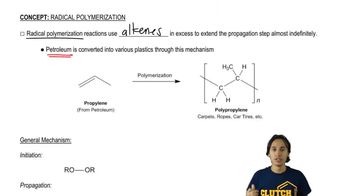
    A chain reaction forming long hydrocarbon chains from alkenes using radicals, producing materials like plastics.
  • Polymer

    A substance composed of thousands of repeating subunits, often resulting in materials with unique properties like elasticity.
  • Alkene

    A hydrocarbon with a carbon-carbon double bond, serving as the main reactant in the chain reaction process.
  • Radical Initiator

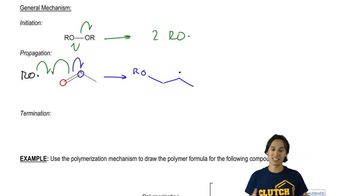
    A compound, such as a peroxide, that generates radicals to start the chain reaction with alkenes.
  • Propagation Step

    The phase where the chain reaction continues, with radicals reacting repeatedly with double bonds to extend the chain.
  • Initiation Step

    The initial phase where a radical is generated and reacts with a double bond to start the chain reaction.
  • Termination Step

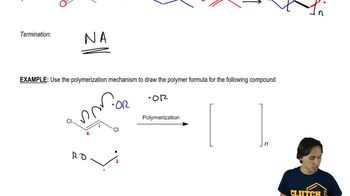
    A phase absent in this process, meaning the chain reaction continues until reactants are depleted.
  • Repeating Subunit

    The structural unit derived from the alkene that is incorporated over and over into the growing chain.
  • Hydrocarbon Chain

    A long sequence of carbon and hydrogen atoms formed during the chain reaction, often thousands of units long.
  • Polypropylene

    A polymer made from propylene, widely used in products like astroturf, car tires, and ropes.
  • Peroxide

    A common industrial compound used to generate radicals for starting the chain reaction.
  • Petroleum

    A natural resource mined for alkenes, serving as the raw material for producing synthetic polymers.
  • Synthetic Material

    A man-made substance, such as plastic, produced through the chain reaction of alkenes.
  • General Formula

    A representation showing the repeating unit and the variable number of units in a polymer chain.
  • Elasticity

    A property of some polymers, allowing them to stretch and return to their original shape.