Back

Fischer Esterification definitions

Control buttons has been changed to "navigation" mode.
1/15
  • Fischer Esterification

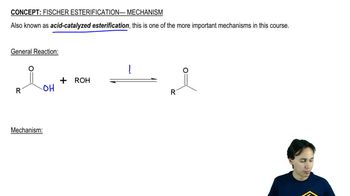
    Acid-catalyzed process converting a carboxylic acid and alcohol into an ester, commonly tested as a nucleophilic acyl substitution.
  • Carboxylic Acid

    Organic compound featuring a carbonyl and hydroxyl group bonded to the same carbon, serving as a reactant in ester formation.
  • Alcohol

    Organic molecule containing a hydroxyl group, acting as a nucleophile in the esterification mechanism.
  • Ester

    Functional group formed by replacing the hydroxyl of a carboxylic acid with an alkoxy group, resulting from esterification.
  • Acid Catalyst

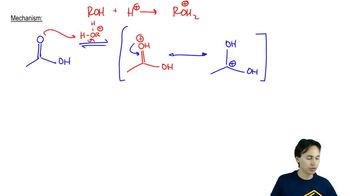
    Substance, often a protonated alcohol, that donates protons to facilitate the esterification mechanism without being consumed.
  • Nucleophilic Acyl Substitution

    Reaction type where a nucleophile replaces a leaving group on a carbonyl carbon, central to ester formation.
  • Protonation

    Initial step involving the addition of a proton to increase electrophilicity, enabling subsequent nucleophilic attack.
  • Nucleophilic Attack

    Step where a nucleophile forms a bond with an electron-deficient carbon, creating a tetrahedral intermediate.
  • Proton Transfer

    Movement of a proton within the reaction intermediate, preparing a group for elimination.
  • Elimination

    Step where a leaving group, such as water, is expelled from the intermediate, forming a new double bond.
  • Deprotonation

    Final step where a proton is removed, regenerating the acid catalyst and yielding the ester product.
  • Resonance Structure

    Alternative Lewis structure showing electron delocalization, often stabilizing intermediates in the mechanism.
  • Reversibility

    Characteristic of the reaction allowing the process to proceed in either direction under suitable conditions.
  • Intermediate

    Transient species formed during the mechanism, existing between reactants and products.
  • Leaving Group

    Atom or group, such as water, that departs from the intermediate, facilitating product formation.