Back

Enantiomeric Excess quiz

Control buttons has been changed to "navigation" mode.
1/15
  • What is the specific rotation of a pure enantiomer sample?

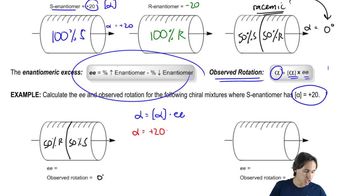
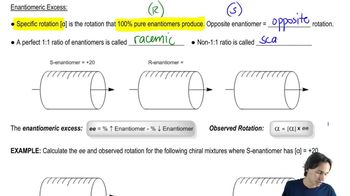
    The specific rotation is the observed rotation when 100% of one enantiomer is present in the sample.
  • What happens to the observed rotation if you have 100% of the R enantiomer and its specific rotation is +10 degrees?

    The observed rotation would be +10 degrees.
  • What is the observed rotation if you have 100% of the S enantiomer and its specific rotation is +10 degrees?

    The observed rotation would be -10 degrees, the same magnitude but opposite sign.
  • What do you call a mixture with a 1:1 ratio of enantiomers?

    A 1:1 mixture of enantiomers is called racemic.
  • What is the observed optical rotation of a racemic mixture?

    The observed rotation is zero because the rotations of the two enantiomers cancel each other out.
  • What is a scalemic mixture?

    A scalemic mixture is a non-1:1 mixture of enantiomers, meaning the proportions are not equal.
  • How do you calculate enantiomeric excess (ee)?

    Enantiomeric excess is calculated by subtracting the percentage of the minor enantiomer from the percentage of the major enantiomer.
  • What does enantiomeric excess represent in a mixture?

    It represents the percentage of the mixture that is optically active and not canceled out by the other enantiomer.
  • How do you calculate the observed rotation of a mixture using enantiomeric excess?

    Multiply the specific rotation of the pure enantiomer by the enantiomeric excess (expressed as a decimal).
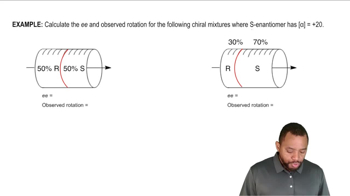
  • If a mixture contains 70% R and 30% S enantiomer, what is the enantiomeric excess?

    The enantiomeric excess is 40% (70% - 30%).
  • If the specific rotation of the S enantiomer is +20, what is the observed rotation for a 100% S sample?

    The observed rotation would be +20.
  • If you have 50% S and 50% R enantiomers, what is the enantiomeric excess?

    The enantiomeric excess is 0%.
  • Why does a racemic mixture have no optical activity?

    Because the optical rotations of the two enantiomers are equal in magnitude but opposite in direction, so they cancel out.
  • What is the formula for observed rotation in terms of specific rotation and enantiomeric excess?

    Observed rotation = specific rotation × enantiomeric excess (as a decimal).
  • Why is enantiomeric excess important in organic chemistry?

    It helps determine the net optical activity of a mixture and indicates the proportion of one enantiomer over the other.