Back

Enantiomeric Excess definitions

Control buttons has been changed to "navigation" mode.
1/13
  • Optical Activity

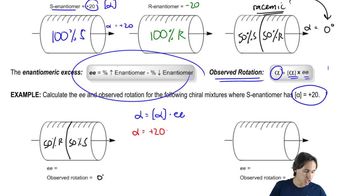
    Phenomenon where a substance rotates plane-polarized light, with the direction and degree depending on molecular composition.
  • Enantiomer

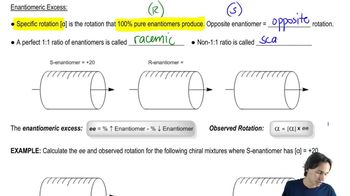
    One of a pair of molecules that are non-superimposable mirror images, each causing opposite optical rotations.
  • Specific Rotation

    Measured degree of rotation for a pure sample of a single enantiomer under standard conditions.
  • Racemic Mixture

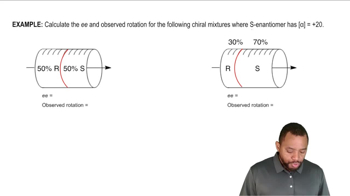
    Equal parts of two enantiomers, resulting in zero net optical rotation due to complete cancellation.
  • Scalemic Mixture

    Unequal mixture of enantiomers, leading to partial optical activity since cancellation is incomplete.
  • Observed Rotation

    Actual measured rotation of plane-polarized light by a sample, reflecting both composition and concentration.
  • Polarimeter

    Instrument used to measure the angle by which a substance rotates plane-polarized light.
  • Alpha Symbol

    Notation representing observed optical rotation, with or without brackets indicating specific or observed values.
  • Enantiomeric Excess

    Numerical difference in percentage between two enantiomers, indicating the proportion responsible for optical activity.
  • Mirror Image

    Spatial arrangement of atoms that is a non-superimposable reflection, characteristic of enantiomers.
  • Configuration

    Three-dimensional arrangement of atoms in a molecule, determining its optical properties.
  • Sample Tube

    Container in a polarimeter holding the solution whose optical activity is being measured.
  • Cancellation

    Effect where equal and opposite optical rotations from enantiomers result in zero net rotation.