Back

EAS:Ortho vs. Para Positions definitions

Control buttons has been changed to "navigation" mode.
1/14
  • Electrophilic Aromatic Substitution

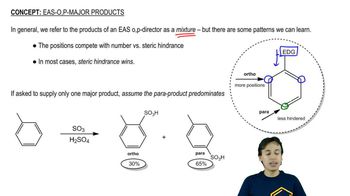
    A reaction where an aromatic ring reacts with an electrophile, replacing a hydrogen atom on the ring.
  • Ortho Position

    A location on a benzene ring adjacent to a substituent, offering two possible sites for substitution.
  • Para Position

    A location on a benzene ring directly opposite a substituent, typically less sterically hindered.
  • Steric Hindrance

    A spatial effect where bulky groups impede access to certain positions on a molecule, influencing product formation.
  • Electron Donating Group

    A substituent that increases electron density on an aromatic ring, directing substitution to ortho and para positions.
  • Ortho-Para Director

    A group that causes incoming substituents to add at ortho and para positions during aromatic substitution.
  • Sulfonation

    A reaction introducing a sulfonic acid group onto an aromatic ring, often used to illustrate regioselectivity.
  • Nitration

    A reaction adding a nitro group to an aromatic ring, commonly used to demonstrate directing effects.
  • Hydrogen Bonding

    An interaction where a hydrogen atom forms a bridge between electronegative atoms, sometimes stabilizing ortho products.
  • Nitronium Ion

    A reactive electrophile generated in nitration, responsible for attacking the aromatic ring.
  • Blocking Group

    A substituent intentionally placed to prevent substitution at certain positions on an aromatic ring.
  • Product Ratio

    The proportion of different isomers formed in a reaction, influenced by both position availability and steric effects.
  • Major Product

    The most abundant compound formed in a reaction, often determined by steric and electronic factors.
  • Minor Product

    A less prevalent compound formed in a reaction, typically due to less favorable conditions or positions.