Back

EAS:Friedel-Crafts Alkylation Mechanism quiz

Control buttons has been changed to "navigation" mode.
1/15
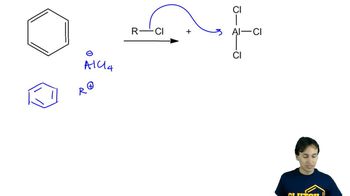
  • What is the role of the Lewis acid (e.g., AlCl3) in the Friedel-Crafts alkylation mechanism?

    The Lewis acid accepts electrons from the alkyl halide, helping to generate a carbocation intermediate.
  • What type of intermediate is formed during the Friedel-Crafts alkylation reaction?

    A carbocation intermediate is formed, which is highly reactive and electron-deficient.
  • Why must you be cautious about carbocation rearrangements in Friedel-Crafts alkylation?

    Carbocations can rearrange to form more stable carbocations, which can change the final product of the reaction.
  • What is the first step in the Friedel-Crafts alkylation mechanism?

    The first step is the generation of a carbocation by transferring electrons from the alkyl halide to the Lewis acid.
  • What does the benzene ring attack during the Friedel-Crafts alkylation mechanism?

    The benzene ring attacks the carbocation intermediate, forming a sigma complex.
  • What is regenerated at the end of the Friedel-Crafts alkylation reaction?

    The Lewis acid catalyst (e.g., AlCl3) is regenerated at the end of the reaction.
  • What byproduct is formed along with the alkylated benzene in Friedel-Crafts alkylation?

    HCl (hydrogen chloride) is formed as a byproduct.
  • Why are primary carbocations generally avoided in Friedel-Crafts alkylation?

    Primary carbocations are very unstable and high in energy, making them difficult to generate and use in the reaction.
  • What typically happens if a primary carbocation is formed during the mechanism?

    A carbocation rearrangement (such as a hydride or alkyl shift) usually occurs to form a more stable secondary or tertiary carbocation.
  • What is a sigma complex in the context of Friedel-Crafts alkylation?

    A sigma complex is an intermediate where the benzene ring has formed a new bond to the alkyl group and carries a positive charge delocalized over the ring.
  • What is the purpose of drawing resonance structures for the sigma complex?

    Resonance structures show the delocalization of the positive charge over the aromatic ring, stabilizing the intermediate.
  • What must you always consider before drawing the final product of a Friedel-Crafts alkylation?

    You must consider possible carbocation rearrangements that could alter the structure of the final product.
  • What happens to the electrons from the C–Cl bond in the alkyl halide during the reaction?

    The electrons from the C–Cl bond are donated to the Lewis acid, facilitating carbocation formation.
  • What is the active electrophile in the Friedel-Crafts alkylation mechanism?

    The active electrophile is the carbocation (R+), which is attacked by the benzene ring.
  • How does the mechanism change if a primary alkyl halide is used?

    If a primary alkyl halide is used, a carbocation rearrangement is drawn in the mechanism to avoid forming an unstable primary carbocation.