Back

Diels-Alder Forming Bridged Products quiz

Control buttons has been changed to "navigation" mode.
1/15
  • When does a Diels-Alder reaction produce a bicyclic bridged product?

    A bicyclic bridged product forms when the diene used in the reaction is cyclic. The cyclic structure leads to the formation of a bridge in the product.
  • What is the key structural difference between products formed from acyclic and cyclic dienes in the Diels-Alder reaction?

    Acyclic dienes produce a simple six-membered ring, while cyclic dienes produce a bicyclic bridged product.
  • What happens to the non-diene portion of a cyclic diene during the Diels-Alder reaction?

    The non-diene portion is pushed out of the way and forms the bridge above the newly formed ring system.
  • How many mechanistic arrows are typically used to show the Diels-Alder reaction mechanism?

    Three mechanistic arrows are used to show the electron movement in the Diels-Alder reaction.
  • What is the role of the 'awkward' carbon in the formation of a bridged bicyclic product?

    The 'awkward' carbon is not involved in the new bond formation and becomes the bridge above the ring.
  • What is the difference between the planar and 3D representations of a bridged bicyclic product?

    The planar representation shows the structure flat, while the 3D representation illustrates the bridge above the ring, clarifying spatial relationships.
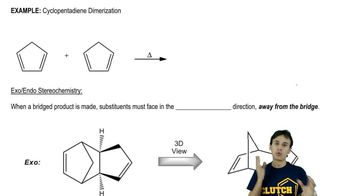
  • What is dimerization in the context of the Diels-Alder reaction?

    Dimerization occurs when the same molecule acts as both the diene and the dienophile, reacting with itself.
  • Why must the diene be in the s-cis conformation for the Diels-Alder reaction?

    The s-cis conformation allows the diene's ends to be close enough to react with the dienophile and form the new ring.
  • How do you determine where to place the double bond in the product of a Diels-Alder reaction with a cyclic diene?

    The double bond is placed between the carbons that received the electron flow (typically carbons 2 and 3 of the diene).
  • What is the significance of the bridge in a bicyclic Diels-Alder product?

    The bridge represents the carbon(s) not involved in the new ring formation, positioned above the main ring system.
  • What are exo and endo orientations in bridged bicyclic Diels-Alder products?

    Exo and endo refer to the relative positions of substituents or rings; endo is oriented away from the bridge, while exo is closer to the bridge.
  • Which orientation, exo or endo, is generally preferred in Diels-Alder bridged products and why?

    The endo orientation is preferred because it minimizes steric (flagpole) interactions between hydrogens or substituents and the bridge.
  • How should you indicate the correct stereochemistry (endo/exo) when drawing a bridged Diels-Alder product?

    Use dashes or wedges to show substituents facing away (endo) or towards (exo) the bridge, and explicitly draw hydrogens if needed to clarify.
  • When is it necessary to draw hydrogens explicitly in Diels-Alder products?

    Hydrogens should be drawn explicitly when stereochemistry is important, such as in endo/exo distinctions.
  • Do you need to consider exo and endo stereochemistry for Diels-Alder reactions with acyclic dienes?

    No, exo and endo stereochemistry is only relevant when a bridge is formed, which occurs with cyclic dienes.